This book collection on music and musical art brings together historical studies of genres, critical essays, theoretical works, and artist memoirs.
Music. Book Collection
- Date:
- from
18 Jul 2025
- Age restrictions
- 18+
T
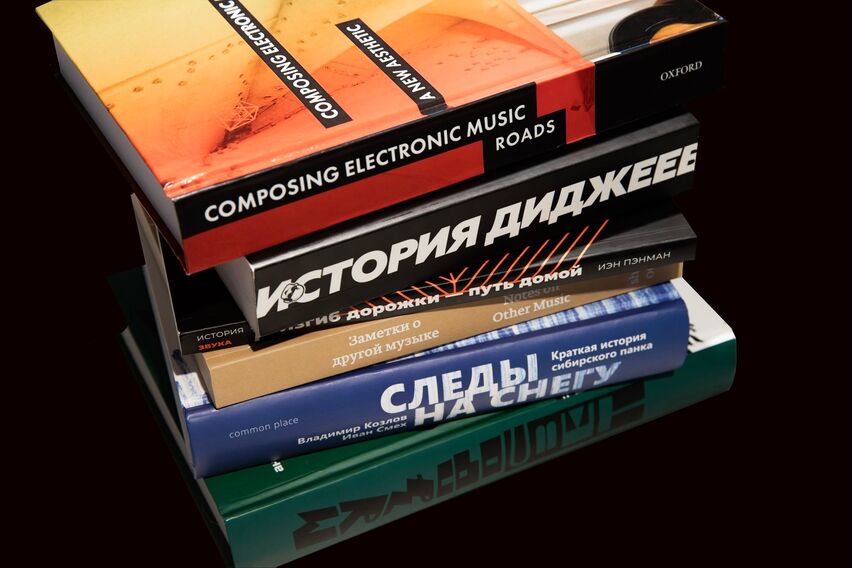
Photo: Anna Zavozyaeva
The relationship between sound and music is both natural and paradoxical. It is difficult to iimagine one without the other, given music is made of sound. Yet, relying on aesthetic criteria, we clearly distinguish between musical and non-musical sound. Sound is often considered in terms of its physical nature and chaotic character: the existence of phenomena beyond human hearing prevents us from perceiving the world of sound in the same way we perceive music. The publications in this collection help refine this distinction and draw attention to the formation of a specific culture — one in which technology, social relations, and science intertwine, creating a foundation for exploring the differences between sound and music.
History
Books on the history of music are fascinating for the different ways in which authors reveal its scale and its cultural, temporal, and geographic boundaries. In particular, the collection includes works by Russian scholars on the development of contemporary music, such as Muzprosvet [Muzprosvet] (in Russian) by Andrey Gorokhov and Grandioznaya istoriya muzy`ki XX veka [A Grand History of Twentieth Century Music] (in Russian) by Artem Rondarev; works on Siberian punk such as Sledy` na snegu [Traces in the Snow] (in Russian) by Vladimir Kozlov and Ivan Smekh; and examinations of the late-Soviet rock underground, such as Alexander Kushnir’s three-volume edition Novaya russkaya muzy`kal`naya kritika. 1993–2003. [New Russian Music Criticism, 1993–2003] (in Russian) and 100 magnitoal`bomov sovetskogo roka [100 Tape Albums of Soviet Rock] (in Russian). Kushnir’s book was read at the House of Culture as part of the reading group The End of Magnetic Tape.
Rather than attempting to grasp the history of music all at once, writers often approached it through individual episodes.. Peter Hook’s The Hacienda: How Not to Run a Club (Russian edition), for example, tells the story of the legendary nightclub that became the focal point of Manchester’s music scene in the 1980s and 1990s, while Dave Hunter’s The British Amp Invasion (Russian edition) explores how advances in the UK’s electronics industry influenced the sound of American guitar pop music.
These smaller stories come together to form a broader picture of musical culture, which often appears fragmented due to the diversity of perspectives and approaches to its study. This is especially evident in studies of electronic dance music and the historical research surrounding it. Our collection offers multiple views on the genre’s evolution. In Last Night a DJ Saved My Life (Russian edition), Bill Brewster and Frank Broughton trace the origins of electronic music through the lens of DJing, while Electrochoc (Russian edition), an autobiographical work by Laurent Garnier and David Brun-Lambert, reflects on key moments in dance music history through the personal experiences of its authors.
Theory
Music scholars do not always approach their subject as a dynamic historical phenomenon that evolves alongside surrounding culture. Some authors treat music as an aesthetic discipline, examining its structure in strictly theoretical terms. A notable example is Ole Kühl’s Musical Semantics (Russian edition) — an interdisciplinary study of music’s sign system that draws on biology, psychology, and cognitive science to explore the emotional foundations of musical experience. The anthology Muzy`kal`ny`e pisateli antichnoj Grecii [Musical Writers of Ancient Greece] (in Russian) presents classical texts examining the nature of music and its relationship to mathematics. Contemporary music theory is well represented by English-language works such as Handmade Electronic Music and Composing Electronic Music — both practical and theoretical guides. The former focuses on the manual construction and modification of instruments, while the latter introduces new aesthetic approaches to musical composition. Theoretical perspectives on music are further enriched by sociological studies, several of which are included in the Library’s collection. Among them are Theodor Adorno’s Sociology of Music (Russian edition), which examines the social functions of art and its role in critiquing mass culture, and Max Weber’s The Rational and Sociological Foundations of Music (Russian edition) in which the German thinker explores music as a rationally organised social phenomenon.
In Dialogue with Musicians
Books based on musicians’ own words — memoirs, interviews, and dialogues — provide insights into the personal experiences of performers and composers. These publications reveal the inner workings of creative processes and artists’ individual viewpoints. Richard Kostelanetz’s Conversing with Cage (Russian edition) explores the philosophy and methods of the great American avant-garde composer. Equally compelling is Glenn Gould Interviews Glenn Gould About Glenn Gould (Russian edition), in which the pianist engages in a self-reflective dialogue that constructs a uniquely personal narrative. A standout in the collection is Notes on Other Music (Russian edition) — a compilation of interviews and reflections on experimental and non-traditional musical practices. Boris Filanovsky’s Shmoczart [Shmozart] (in Russian) is a professional diary in which the composer dissects his creative routine, combining technical analysis with observations and anecdotes. In A Brief History of New Music (Russian edition), Hans Ulrich Obrist surveys contemporary musical art through a series of interviews with leading composers and performers. Also of note is Boris Belokurov’s (Usov’s) book E`l`d [Eld] (in Russian) — not a memoir, but a poetic work in which verse and musical imagery intertwine, offering a glimpse into the author’s inner world and creative purpose.
From Irina Antonova’s Personal Collection
A vital part of this collection consists of books from the personal library of Irina Antonova (1922–2020) — a distinguished art historian, cultural figure, and former director of the Pushkin State Museum of Fine Arts. These books are significant not only because of their provenance but also for the unique range of topics and musicians they cover.
Among them are: Istoriya aresta Genrixa Gustavovicha Nejgauza [The Story of Heinrich Gustavovich Neuhaus’s Arrest] (in Russian), a documentary narrative about the fate of the great pianist; Muzy`ka k fil`mu Sergeya E`jzenshtejna Ivan Grozny`j [Music for Sergei Eisenstein’s Film Ivan the Terrible] (in Russian), which explores Sergei Prokofiev’s work on the score for the renowned Soviet director’s final film; and The Van Cliburn Legend (Russian edition) — a story about the legendary American pianist, with a foreword by Dmitri Shostakovich. Also featured are multi-volume works like Romain Rolland’s History of Music (Russian edition), which provides a broad cultural and historical context, and the French two-volume Dictionnaire de la Musique — an essential reference on musical terminology and biographies of great composers and performers.