This collection offers a multifaceted view of Rabindranath Tagore’s legacy, bringing together biographies, scholarly editions of his works, studies in postcolonial theory, and catalogues of contemporary Indian art.
Around Tagore. Book Collection
- Age restrictions
- 18+
T
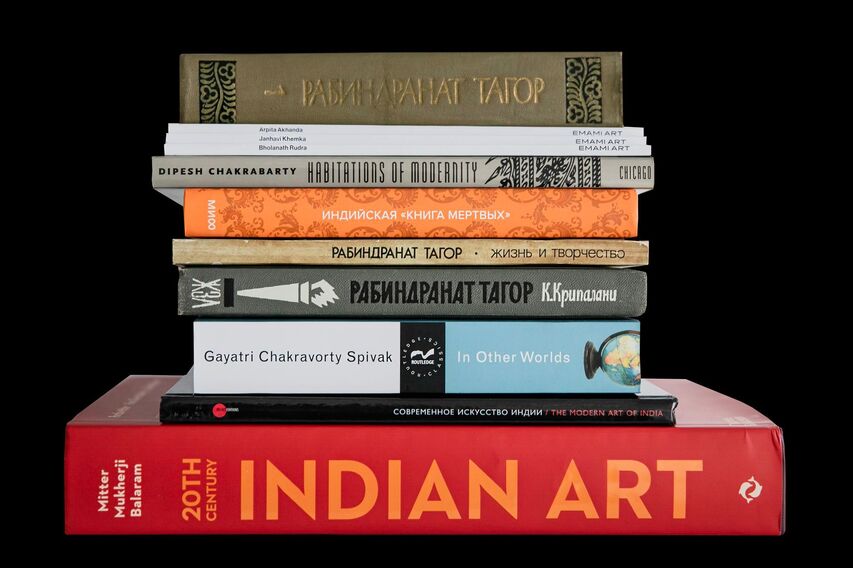
Photo: Anya Todich
Tagore Studies
The biography of Rabindranath Tagore written by his associate Krishna Kripalani was first published in Russian in 1983 as part of the Zhizn’ zamechatel’nih lyudey [Lives of Remarkable People] series by the Molodaya Gvardiya publishing house. Our collection includes both the original edition and its modern 2025 reissue.
The central place in this collection is occupied by the collected works of Rabindranath Tagore. The twelve-volume Russian edition published by Khudozhestvennaya Literatura was prepared on the basis of the twenty-eight-volume scholarly collection issued by Visva-Bharati University, which Tagore himself founded. The Russian-language volumes include almost all of Tagore’s novels and short stories, most of his poetry, and a significant number of his dramatic works. In addition to fiction, the final two volumes contain lectures on the history of Indian culture, journalism, and memoirs, presenting Tagore not only as a poet and writer but also as a thinker, educator, and cultural reformer.
This collection also includes two books on Rabindranath Tagore published in the early twentieth century. The first is an anthology, Ex Oriente Lux!—Latin for "Light from the East!"—which brings together the work of three poets: Tagore represents the Indian poetic tradition, Sikun Tu the Chinese tradition, and Selman Savji the Iranian tradition. The second is a work by the German pastor and author Emil Engelhardt. Entitled Rabindranat Tagor: kak chelovek, poet i mislitel’ [Rabindranath Tagore: As a Man, Poet, and Thinker], Engelhardt’s book pays particular attention to the spiritual dimension of the Indian philosopher’s life and work.
Pis’ma o Rossiyi [Letters about Russia] captures Rabindranath Tagore’s impressions of his journey to the Soviet Union in 1930. During his visit, Tagore actively engaged with representatives of the Soviet intellectual and social milieu. He was especially interested in education, collective forms of social organisation, nationality policy, and the harmonious development of the individual under new social conditions. Tagore’s observations and reflections make the book a rare document of intercultural dialogue.
In 1961, several commemorative publications marked the centenary of Rabindranath Tagore’s birth. These included a booklet by Emmanuel Borovik, designed as a methodological guide for lecturers introducing Tagore to student audiences, as well as a substantial collection of essays. Alongside topics traditionally associated with Tagore studies, this volume examined less obvious aspects of Tagore’s legacy, including linguistic approaches to his work and his role in the development of Indian musical culture. 1961 also saw the publication of a critical and biographical study of Tagore by the philologist Alexander Gnatyuk-Danilchuk, supplementing the scholarly context with a more comprehensive view of the writer and educator’s life and work.
The 1980s saw the publication of a number of works that deepened understanding of Tagore’s legacy by addressing more specialised aspects of his creative work and worldview. These included Viktor Ivbulis’s philological study Literaturno-khudojestvennoye tvorchestvo Rabindranata Tagora [The Literary and Artistic Work of Rabindranath Tagore] and Evdokia Gosteyeva’s Filosofiya edinstva [The Philosophy of Unity], which provided a detailed analysis of the philosophical dimension of Tagore’s thought. This period also saw the publication of the essay collection Rabindranat Tagor: Zhizn’ i tvorchestvo [Rabindranath Tagore: Life and Work], edited by Yevgeny Chelyshev. Bringing together studies by various authors, it reflects the mature stage of Russian scholarship on Tagore.
Rabindranath Tagore was not only a thinker and poet but also an artist whose works combined the Indian tradition with elements of Western modernism. Tagore’s visual legacy is explored in the catalogue My Pictures: A Collection of Paintings by Rabindranath Tagore. Another important publication for understanding Tagore’s artistic legacy is Wings of Mistakes: Doodles of Rabindranath Tagore, which presents a body of griffonage—improvised, rapidly executed drawings and sketches made in the margins of manuscripts.
The Indian Context
This section of the book collection sets the figure of Rabindranath Tagore within the broader context of Indian history and culture in which his legacy developed.
The exhibition catalogue India and the World: A History in Nine Stories presents India’s millennia-long history through material objects, ranging from ancient stone axes and medieval armour to paper money and legal documents. These artefacts are not considered in isolation, but as evidence of global interactions. Comparing textile patterns from Egypt to Indonesia, for example, reveals a network of cultural parallels and recurring visual motifs.
On the Paths of Enlightenment: The Myth of India in Western Cultures 1808–2017 is an extensive collection of archival documents and works of art that traces the history of Western perceptions of India. It encompasses a wide range of examples, from Vaslav Nijinsky’s costumes for Diaghilev’s productions to the images and practices of American hippie culture. The book allows readers to trace the evolution of the myth of India across different historical and cultural contexts.
Two popular scholarly publications introduce readers to Indian mythology and religious traditions. Devdutt Pattanaik’s Indiyskiye mifi [Indian Myths] presents the central narratives, deities, and symbols of Indian culture in an accessible form. Indiyskaya “Kniga mertvikh”: issledovaniye mrachnogo ada, luchezarnogo raya i putey v strani bogov i umershikh [The Indian “Book of the Dead”: A Study of the Gloomy Hell, the Radiant Paradise, and the Paths to the Realms of Gods and the Deceased] examines the sacred text known as the Garuda Purana, which contains teachings concerning life and death.
Postcolonial Theory
Postcolonial thought occupies an important place in India’s philosophical and theoretical legacy. In Dominance without Hegemony: History and Power in Colonial India, the historian Ranajit Guha analyses the colonial state. In History at the Limit of World-History, Guha reconsiders conventional understandings of world history through a postcolonial lens, drawing in part on the ideas of Rabindranath Tagore.
Tagore also emerges as a key figure in the work of the historian Dipesh Chakrabarty. In Provitsializiruya Evropu [Provincializing Europe], Chakrabarty examines Tagore’s place in the intellectual debates of his time through an analysis of Bengali literature, paying particular attention to the criticism Tagore received from his contemporaries. This collection also includes other works by Chakrabarty, such as Ob antropotsene [On the Anthropocene] and Habitations of Modernity: Essays in the Wake of Subaltern Studies, in which the Indian philosopher reconsiders the foundations of modernity and universalist models of historical knowledge.
The theorist Partha Chatterjee explores the concepts of nation and nationalism in the essay collection The Partha Chatterjee Omnibus. These essays criticise Western models of the nation-state and propose alternative ways of understanding political community. This postcolonial line of inquiry is continued by Gayatri Chakravorty Spivak in her celebrated essay Mogut li ugnetenniye govorit’? [Can the Subaltern Speak?]. Spivak further develops her ideas concerning the representation of oppressed groups in In Other Worlds: Essays in Cultural Politics.
In Tagore’s Footsteps
The final section of this collection is devoted to contemporary Indian art. The exhibition The World in a Single Nest: Following the Way of Tagore presented works by contemporary artists who enter into dialogue with Tagore’s artistic and philosophical legacy. This section of the book collection emphasises the ways in which Tagore’s thought continues to resonate in contemporary creative practices.
The historical development of Indian visual art and the outlines of the contemporary art scene can both be traced in the India-themed 2015 issue of the magazine Iskusstvo [Art]. The issue includes art-historical essays as well as an interview with members of the Raqs Media Collective, who occupy an important place in the field of contemporary art and whose works are featured in the World in a Single Nest exhibition.
Monographic catalogues devoted to contemporary Indian artists and published by Emami Art offer a representative cross-section of the country’s current artistic landscape. Among them is a volume on Prasanta Sahu, whose art was also included in the Around Tagore exhibition. Sahu studied at Visva-Bharati University, which was founded by Rabindranath Tagore. The catalogue allows us to consider Sahu’s practice within a tradition centred on dialogue between local heritage and contemporary artistic forms.
This collection also includes Forming in the Pupil of an Eye: Guide A—Z. Kochi—Muziris Biennale 2016, a catalogue-guide documenting the contemporary art festival held in the Indian state of Kerala. The book is written in Malayalam, a language widely spoken in south-western India, with a parallel English translation. This section is supplemented by catalogues of exhibitions held by the Birla Academy of Art and Culture, covering the institution’s activities from 1976 to 2025. The collection also includes the annual programme reports of the Indian gallery Experimenter: Program 2023 and Program 2024. These publications provide an overview of the current state of India’s art scene and its most important figures.