A book collection exploring recent academic inquiries into the architecture of Soviet modernism accompanying the Moscow — Hanoi: Landscapes of Optimism exhibition.
Stories about the History of Soviet Modernism
- Age restrictions
- 18+
T
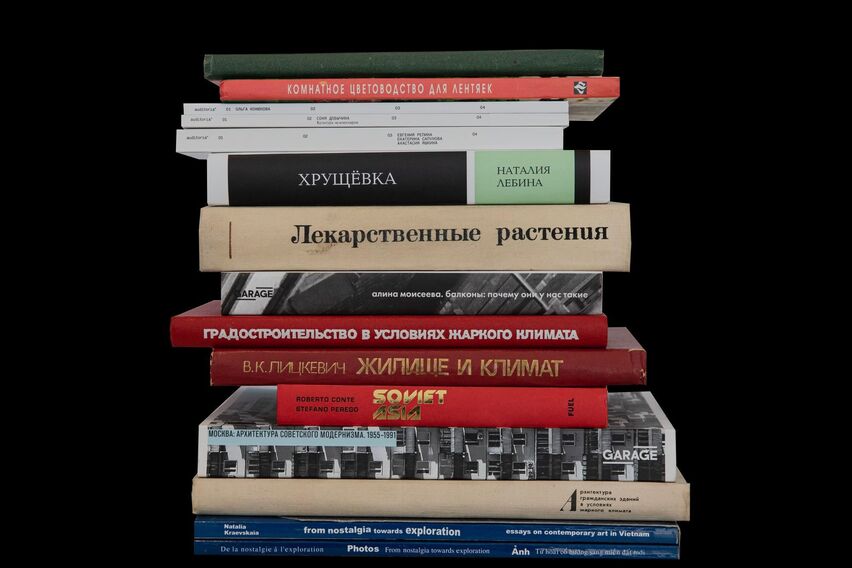
Photo: Anya Todich
How familiar are you with Soviet architecture of the 1950s—1980s? It may seem that nothing could be simpler or easier to understand than the standardised housing of that period—but what do we really know about it? Though widespread interest in the subject emerged only relatively recently, in the early 2010s, over the past fifteen years, numerous research projects have been carried out. How did this process begin, what questions did researchers ask, and what did they achieve?
Soviet modernism was introduced to a broad audience through several exhibitions and striking photography books. These books presented a vivid image of the architecture of “Soviet cosmism,” but did little to explain it. In 2010, Felix Novikov’s album Soviet Modernism: 1955–1985 was published by TATLIN in Yekaterinburg. A connoisseur of notable publications of the period would have set it beside Frédéric Chaubin’s now-iconic photobook CCCP: Cosmic Communist Constructions Photographed, which was released a year later. Though this magnificent volume has been reprinted 45 times over fifteen years, it has never been translated into any of the languages that were spoken in the Soviet Union. Chaubin’s photography skilfully presented Soviet buildings without burdening them with lengthy interpretation, and in doing so sparked a wave of renewed interest in Soviet architecture.
Over time, Soviet modernism became increasingly popular. It became fashionable to photograph, discuss, and romanticise the “chthonic gloom” of standardised residential developments. The history of architectural photography during this period— the way photographers were able to transform neglected buildings into striking and minimalist architectural images—deserves its own separate study. It was likely in part through the distinctive aesthetics of these images that we came not only to recognise the value of this architecture, but also to launch reconstruction projects.Notable photographers and publications include, among others: Christopher Herwig’s Sovetskiye avtobusniye ostanovki [Soviet Bus Stops] (2015); Roberto Conte and Stefano Perego’s Soviet Modernist Architecture in Central Asia (2019); Alex Bykov and Yevgenia Gubkina’s Soviet Modernism. Brutalism. Post-Modernism: Buildings and Structures in Ukraine 1955–1991 (2019); the albums produced by Zupagrafika—Monotowns: Soviet Landscapes of Post-Industrial Russia (2021), Soviet Playgrounds: Playful Landscapes of the Former USSR (2022), Kiosk: The Last Modernist Booths Across Central and Eastern Europe (2024) and, Yuri Palmin’s photographs, which have appeared in various books about modernism.
Architectural photography books play an important role in shaping our aesthetic understanding of an era. It is, however, easy to dismiss them as frivolous “coffee-table books,” and, in the case of Soviet modernism, to come away with little more than jokes about how a Soviet children’s summer camp could stand in for an alien base in a Hollywood film. Yet it was precisely through such associations that Soviet modernism became a distinctive, self-sufficient brand.
Alongside these striking albums, academic studies—many of them the work of international researchers—contributed to widespread interest in the subject. Those wishing to view Soviet architecture through foreign eyes should turn to Steven Harris’s Communism on Tomorrow Street: Mass Housing and Everyday Life after Stalin (2013), or Richard Anderson’s bestselling Russia: Modern Architectures in History (2015), which traces the history of Russian architecture from 1861 to the 1990s.
Large-panel housing construction, the defining feature of Soviet architecture in the 1960s—1980s, long remained a marginal subject that attracted little attention from //architectural historians. The turning point came in 2015 with the publication of a book that told the history of mass-produced housing for the first time and described 25 of the best-known standardised design series in detail. A Russian edition appeared in 2018, becoming the only—and most important—publication on the subject in the “native” language of the buildings themselves. The book in question was Dmitry Zadorin and Philipp Meuser’s K tipologiyi sovetskogo tipovogo domostroyeniya. Industrial’noe zhilishnoe stroitel’stvo v SSSR [Towards a Typology of Soviet Standardized Housing Construction: Industrialized Housing in the USSR], which demonstrated that standardised housing was not a by-product of technical or economic processes, but rather a reflection of the central socialist idea of standardisation.
A Russian reader may take it as self-evident that Soviet modernism and standardised architecture emerged during the period when Nikita Khrushchev was General Secretary of the Central Committee of the Communist Party of the Soviet Union. International studies, however, make it clear that Khrushchev was by no means the inventor of industrialised housing. In Spatial Revolution: Architecture and Planning in the Early Soviet Union (2022), Christina Crawford helps us see the standardised housing of the Khrushchev era not as a break with the Stalinist period, but as a continuation and large-scale realisation, on an industrial basis, of ideas first developed during the early Five-Year Plans of the 1930s, including the socialist city, linear planning, the collectivisation of everyday life, and the involvement of international architects such as Ernst May. Crawford traces the early ambition of Soviet urban planning, and allows us to see Soviet panel buildings as manifestations of global processes rather than of Khrushchev’s personal preferences. The adoption of large-panel housing emerges not just as the story of a change in style—from Stalinist Empire to Khrushchev-era minimalism—but as the story of how the world addressed social resettlement and the reconstruction of cities after the Second World War.
Another important study in this field appeared in 2021—Miles Glendinning’s Mass Housing: Modern Architecture and State Power—A Global History. Glendinning’s work explores what forms homes “for the people” took in different countries. It sets housing in the USSR alongside concrete blocks in Brazil, Hong Kong, China, Mexico, Canada, South Korea, and Japan. Łukasz Stanek’s Architecture in Global Socialism: Eastern Europe, West Africa, and the Middle East in the Cold War (2022) continues this global approach. Stanek shows that socialist architecture was a global phenomenon rather than something confined to the borders of the USSR. Soviet and Eastern European architects worked in Ghana, Nigeria, Iraq, the United Arab Emirates, and Kuwait. They built universities and ministries, designed city master plans, and actively competed with Western architectural firms in countries outside the Soviet bloc.
Another account of the global circulation of architectural approaches is presented by Pedro Ignacio Alonso and Hugo Palmarola in Flying Panels: How Concrete Panels Changed the World (2019). This book grew out of research first presented at the Chilean Pavilion at the 2014 Venice Architecture Biennale, which explored the history of a Soviet large-panel housing factory donated to Chile under Salvador Allende’s government in 1972. The authors view large-panel construction not as a uniquely Soviet phenomenon, but as an important element of twentieth-century global architectural history that connected countries on both sides of the Iron Curtain. Alonso and Palmarola trace the journey of the concrete panel from French experiments in the 1950s to buildings in Chile, Cuba, Angola, Finland, and Japan, treating concrete panel construction as a technological and ideological object//export that was transported, copied, and adapted to radically different political, climatic, and social conditions.
Alonso and Palmarola examine the panel from the “top down,” focusing on the routes and patterns through which the technology travelled. Christina Schwenkel, by contrast, descends to the scale of a single city in Building Socialism: The Afterlife of East German Architecture in Urban Vietnam (2020). Schwenkel tells the remarkable story of how Vinh, a Vietnamese city destroyed by American bombing, was rebuilt in the 1970s by architects from East Germany. Schwenkel is first and foremost an anthropologist, and her book is compelling because it is not limited to archives and drawings. She listens closely to residents of Vinh’s panel-built neighbourhoods—what they think about the socialist legacy, how they inhabit and adapt these buildings, what the “German quarter” means to them half a century later. Here, the modernist panel building is viewed through the lives of its inhabitants, while the architecture of international solidarity emerges as a living and contradictory experience.
Related themes are explored in a volume edited by Vladimir Kulić. Second World Postmodernisms: Architecture and Society under Late Socialism (2020) centres on the questions of whether postmodernism existed in the socialist world, and how it was related to its Western counterpart. Drawing on the architecture of Yugoslavia, Hungary, Poland, the USSR, East Germany, and Czechoslovakia, Second World Postmodernisms shows that the 1970s and 1980s were marked not only by fatigue with the uniformity of mass housing, but also by a search for new forms of expression—regional motifs, historical quotations, irony, and engagement with national traditions. The postmodernism of the “Second World” emerges as an independent chapter in the broader history of the movement.
A satisfying conclusion to this complex journey towards an understanding of Soviet modernist architecture was provided by the publication of guidebooks to cities with substantial modernist heritage. The series naturally began with Moscow, when Garage Publishing released Moskva: arkhitektura sovetskogo modernisma. 1955-1991 [Moscow: Architecture of Soviet Modernism, 1955–1991]. The guide was written by the architectural historians Anna Bronovitskaya and Nikolay Malinin, with photographs by Yuri Palmin. It was followed by Leningrad: arkhitektura sovetskogo modernisma. 1955-1991 [Leningrad: Architecture of Soviet Modernism, 1955–1991] and Alma-Ata: arkhitektura sovetskogo modernisma. 1955-1991 [Alma-Ata: Architecture of Soviet Modernism, 1955–1991] by the same authors. The series then began to encompass capitals of former Soviet republics ,and is likely to eventually cover them all. Already published are Yerevan: arkhitektura sovetskogo modernisma. 1955-1991 [Yerevan: Architecture of Soviet Modernism, 1955–1991] by Anna Bronovitskaya, Yuri Palmin, and Elena Markus, and Tashkent: arkhitektura sovetskogo modernisma. 1955-1991 [Tashkent: Architecture of Soviet Modernism, 1955–1991] by Olga Kazakova and Boris Chukhovich.
To conclude, it is worth paying tribute to the origins of the extraordinary Soviet narrative about humanity’s conquest of nature. How did the creators of large-panel modernism describe it? Such an overview might begin with the concept’s own self-description. In 1959, just as the first plants capable of producing thousands upon thousands of panels were commissioned, Boris Rubanenko published 9-y kvartal v Novikh Cheremushakh. Opitno-pokazatel’noye stroitel’stvo zhilogo kvartala v Moskve [The Ninth District in Novye Cheryomushki: Experimental and Model Construction of a Residential District in Moscow]. Mayakovsky’s line, “Here a garden city will rise” provides an apt description of Rubanenko’s book. This early vision of mass housing imagined it as providing a welcoming neighbourhood, complete with factory-made supports for climbing plants on balconies, fountains in the courtyards, and the hope that Soviet housing would draw upon the very best available models. Inside these outwardly identical boxes were a great many living, human ideas.
Special mention should also be made of Nikolay Rozanov’s foundational work Krupnopanel’noe domostroyeniye [Large-Panel Housing Construction], published by Stroyizdat in 1982. The book describes experiments with reinforced-concrete panels during the Stalinist period, and Soviet engineers’ study of international experience, such as French, American and Swedish technologies and prefabrication systems. The book seems to come directly from the forge of the housing-construction industry, immersing the reader in genuine technical problems without yet—quite understandably, given its year of publication—raising questions about the theoretical interpretation of what was taking place. A book about Rozanov appeared during the same period under the telling title Pioner industrial’nogo domostroyeniya [A Pioneer of Industrialized Housing Construction] (1980), a biography of the man who developed the most extensively-built design ever produced on our planet: the 1-464 series, which was manufactured at hundreds of housing-construction plants around the world.