This book collection brings together inquiries into a familiar physical phenomenon—the phenomenon of sound—from philosophical, anthropological, and biological perspectives.
Sound. Book collection
- Date:
- from
15 Oct 2024
- Age restrictions
- 18+
T
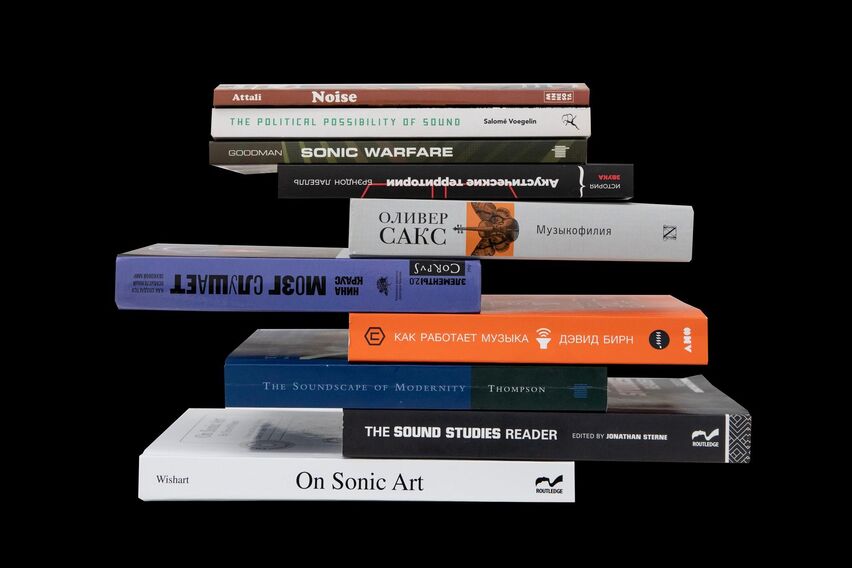
Photo: Vadim Shtein
This collection is founded on literature from the field of contemporary sound studies, a discipline which examines the diversity of ways in which sound is perceived across different cultures. In his introduction to The Sound Studies Reader, Jonathan Sterne identifies key characteristics of work in this field: the simultaneous use of various approaches to understanding acoustic phenomena—such as media archeology, discourse analysis, and critical theory—and a commitment to the historicity of knowledge.
The nature of sound is fluid, and its perception is highly context-dependent due to cultural differences. Interdisciplinary analysis allows us to move closer to an adequate understanding of what we hear. Sound studies mark a departure from attempts to provide a definitive, once-and-for-all characterisation of acoustic phenomena—contrasting with earlier approaches in the socio-cultural study of sound. From a historical perspective, Jacques Attali’s classic work Noise: The Political Economy of Music is of interest, arguing that noise is always a form of violence. By contrast, the British musician and theorist Steve Goodman’s Sonic Warfare: Sound, Affect and the Ecology of Fear exemplifies more recent methods in sound studies. Goodman is less categorical, and concludes that noise can be a source of both pain and pleasure. Unlike Attali, he emphasises the instability and variability of auditory experience.
The issue of the materiality of sound is addressed by works added to the Library’s collection as part of the “Tuning” programme series held at
This collection also includes popular science works in which scholars and musicians explain—from the perspectives of neuroscience, psychology, and everyday experience—the secrets of musical art and the ways sound affects the human inner world. Unlike contemporary sound studies, these works do not engage extensively with the complex theoretical debates at the intersection of technology, philosophy, and politics. Instead, they present the physical, cognitive, and neurobiological dimensions of sound perception in an accessible and engaging manner, making scientific insights about music and listening available to a broad readership. In Muzykofiliya [Musicophilia], British scholar Oliver Sacks draws on medical theory, his own neurological practice, and examples from fiction. Studying how the nervous system and brain register sound, Nina Kraus explains the interactive nature of listening in Mozg slushaet. Kak sozdaetsya osmyslennyy zvukovoy mir [Of Sound Mind: How Our Brain Constructs a Meaningful Sonic World]. David Byrne—frontman of Talking Heads, songwriter, and producer—offers his own perspective on the phenomenon of musical creativity in his autobiographical work Kak rabotaet muzyka [How Music Works].