This collection complements the Eternity Formulae exhibition, bringing together publications on architectural utopias, classical art, and the mysteries of the cosmos.
Eternity Formulae. Book Collection
- Age restrictions
- 18+
T
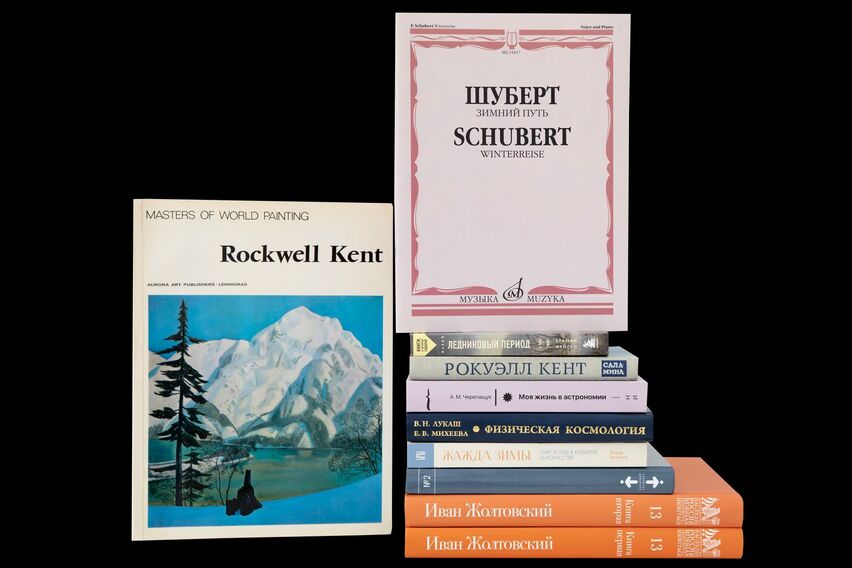
Photo: Anna Zavozyaeva
The Refrigerator
The Eternity Formulae exhibition presented archival materials related to the construction of one of Europe’s largest industrial refrigeration buildings in Moscow. It traced the complex evolution of this refrigeration building’s design, notably the transition from the Venetian motifs characteristic of Stalinist architecture to the laconic aesthetics of large-panel construction that anticipated 1960s Soviet architecture.
The first section of this collection includes studies devoted to Ivan Zholtovsky, the architect of the industrial refrigeration building, and to Soviet urban planning more generally. I. E. Pechyonkin and O. S. Shurygina’s two-volume edition Arkhitekturnoe nasledie Rossii. Ivan Zholtovskiy [Architectural Heritage of Russia: Ivan Zholtovsky] describes Zholtovsky’s approach: his attention to proportion, his interest in Renaissance composition, and, at the same time, his readiness to work with new construction technologies.
A dialogue with Andrea Palladio, the great sixteenth-century Italian architect, runs throughout Zholtovsky’s work—as both a scholar and an artist, Zholtovsky’s engagement with classical tradition never meant mere quotation. The Library holds both the primary source, Palladio’s Chetyre knigi ob arkhitekture [The Four Books of Architecture], and literature devoted to the broader debate on the relationship between tradition and modernity, the old and the new. Spor o drevnikh i novykh [The Quarrel of the Ancients and the Moderns] presents a seventeenth-century polemic on whether architecture should rely on the authority of antiquity or, conversely, seek and assert new artistic ideas and techniques. T. S. Eliot’s classic essay Traditsiya i individual’nyy talant [Tradition and the Individual Talent] highlights how any modern creative statement inevitably arises in dialogue with heritage.
Y. L. Kosenkova’s study Sovetskiy gorod 1940-kh — pervoy poloviny 1950-kh godov [The Soviet City of the 1940s—First Half of the 1950s] allows readers to delve deeper into the Soviet urban planning that was contemporary to Zholtovsky and his project. Kosenkova analyzes a period of intense transformation of urban space, during which architecture had to respond simultaneously to the demands of economy, ideology, and state plans for mass housing construction. Meanwhile, Ivan Atapin’s book Utopiya v snegakh [Utopia in the Snows] addresses the fate of architectural heritage in another geographical region of Russia—Siberia.
Fiction adds an emotional and symbolic dimension to the architectural history of the industrial era. Fyodor Gladkov’s 1925 novel Tsement [Cement], which foregrounds the industrial enthusiasm of the 1920s, establishes an early model for the artistic interpretation of socialist construction—the noticeable plainness of its literary language is an attempt at a simplification of expressive means that was characteristic of Soviet art, and which by the late 1950s had also become characteristic of architecture. Andrei Platonov’s Schastlivaya Moskva [Happy Moscow], depicts the industrial rhythm of the Soviet capital differently: Moscow is at once a space of grand ambitions and scientific faith in the transformation of humanity and an environment whose mechanistic nature conflicts with human fragility.
Winterreise
The second section of the exhibition—"Winterreise"—was devoted to images of the cold and winter in European visual art from the seventeenth to the twentieth century. The poetic and philosophical motifs central to this section are reflected by its title—"Winterreise" is the name of a cycle of twenty-four songs by the German composer Franz Schubert setting poems by Wilhelm Müller. The Library holds a printed score of this work. Through Winterreise’s dazzling imagery and symbolic richness, Schubert discovered not only a language for expressing the burden of the artist and existential solitude, but a path to one of the most desired victories—the triumph of art over the obstacles that impede its creation, over the melancholy which causes hope to freeze and the human spirit to grow cold. Our collection also holds Schubert’s poetic, reflective, and romantically expressive texts in the volume Frants Shubert. Perepiska, zapisi, dnevniki, stikhotvoreniya [Franz Schubert: Correspondence, Notes, Diaries, Poems].
The second part of this book collection explores cold both as a stable artistic image and aesthetic construct and as an object of scientific inquiry. The collection Obraz/y Severa v russkom i evropeyskom iskusstve [Image(s) of the North in Russian and European Art] brings together interdisciplinary studies in architecture, literature, music, and cinema, demonstrating how representations of the North vary across different cultures. Polyarnyy al’manakh [The Polar Almanac] complements this perspective with materials on the exploration of the Arctic and Antarctica, returning the discussion of winter to the domains of geography and the history of science. Bernd Brunner’s Zhazhda zimy [The Winter’s Tale: A Cultural History of Snow and Ice] offers a cultural history of winter—from the poetics of snowflakes to rituals and everyday practices—while Global’noe poteplenie: kartografiya rossiyskikh klimaticheskikh nauk [Global Warming: Cartography of Russian Climate Science] pays attention to the current state of climate research, reminding us that the image of cold today is inseparable from the anxious awareness of its possible disappearance.
Fiction contains many vivid depictions of winter, and images of cold often serve as the backdrop for moral choice and existential trial. In Leo Tolstoy’s stories Metel’ [The Snowstorm] and Khozyain i rabotnik [Master and Man]—remarkable examples of the writer’s early and late styles, written 39 years apart—a “winter journey” becomes the stage for the inner transformation of characters. Sigrid Undset’s historical trilogy Kristin, doch’ Lavransa [Kristin Lavransdatter] transports the reader to medieval Norway, where the harsh climate forms a backdrop to drama, human passion, and faith. The romantic individualism characteristic of Norwegian writers of the early twentieth century is also apparent in the collection Ukhod v les. Sibirskaya gamsuniana: 1910–1920-e gody [Into the Forest: A Siberian Hamsuniana (1910s—1920s)], which includes prose by lesser-known Siberian authors. Finally, Elena Popova’s contemporary autofiction novel Vos’midesyatyy gradus [The Eightieth Degree] reflects on the North through the imagery of scientific expeditions.
The third part of this section turns to artists whose works shape the visual contours of the “winter journey.” Rembrandt is the subject of Marcel Proust’s essay Chardin and Rembrandt, included here in a pocket English-language edition; a fuller view of the Dutch master’s art is offered in the album Rembrandt: The Complete Paintings. Salamina [Salamina], an autobiographical narrative by the artist Rockwell Kent, whose works are featured in the Eternity Formulae exhibition, transports readers to Arctic Greenland. The catalogue of Alexandra Paperno’s exhibition Lyubov’ k sebe sredi ruin [Self Love Among the Ruins] offers the artist’s own commentary on her Cancelled Constellations series, featured in the next section of exhibition.
Cosmic Microwave Background
In the third section of the Eternity Formulae exhibition, cold appeared as a fundamental property of the Universe itself—a background against which the movement of matter and the light of distant objects become perceptible. The cosmic microwave background preserves faint traces of the early history of the cosmos that continues to shape its present. Problemy sovremennoy astrofiziki [Problems of Modern Astrophysics], a popular science book by Iosif Shklovsky—a Soviet astronomer and among the first to introduce the concept of the cosmic microwave background into Soviet academic discourse—acquaints readers with the mechanisms of scientific thinking, describing cosmic processes in terms of models, probabilities, and measurements. For those seeking not only a general overview but a rigorous scientific account, V. N. Lukash and E. V. Mikheeva’s Fizicheskaya kosmologiya [Physical Cosmology] provides a detailed explanation of how, in terms of general relativity and quantum gravity, the matter flows, galaxies, and large-scale structure of the Universe were formed.
Another perspective is provided by books written by astrophysicists themselves: Moya mirovaya liniya [My World Line] by Georgy Gamow and Moya zhizn’ v astronomii [My Life in Astronomy] by Anatoly Cherepashchuk. These texts combine scientific reasoning with the human dimension of research, presenting the cosmos as a space of prolonged observation, doubt, and intellectual risk. Both scientists made important contributions to the field: Georgy Gamow was one of the authors of the hot Universe theory and predicted the existence of the cosmic microwave background, while Anatoly Cherepashchuk headed the Sternberg State Astronomical Institute for more than thirty years, from 1986 to 2018.
Unexpected approaches to astrophysical themes are offered by Ewald Ilyenkov’s philosophical work Kosmologiya dukha [Cosmology of the Spirit] and Liu Cixin’s science fiction novel Zadacha trekh tel [The Three-Body Problem]. In Liu Cixin’s epic, the cosmic microwave background becomes a narrative element: the artificially induced “flickering” of the cosmic background signals interference by extraterrestrial intelligence, while the cold of the Universe becomes a medium of communication and threat. Ilyenkov, on the other hand, offers a different perspective: reflecting on the fate of the Universe in light of heat death theory and the laws of thermodynamics; Ilyenkov is concerned less with physics than with the place of thought in the cosmic circulation of matter, integrating the problem of cold into a philosophical vision of universal interaction.
Following the Eternity Formulae exhibition, the books in this selection speak to the possibility of search and discovery: both in classical works of art and in the cosmic noise of the Universe, we encounter the nature of our own sensitivity as a fundamental condition of creativity.