The first
Deaf and Hearing. Deaf Education. Book Collection
- Age restrictions
- 16+
T
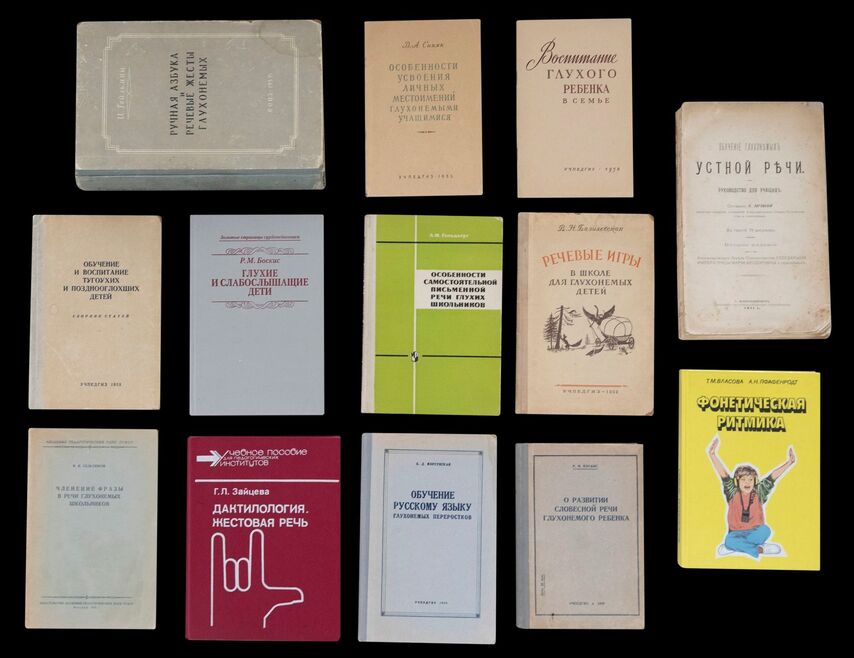
Photo: Ruslan Shavaleev
Compiled by
Vlad Kolesnikov is hard of hearing and a specialist in Deaf education and special education. He curates programs for the Deaf community at
Deaf education is a practice-oriented field. It seeks solutions to specific questions concerning the education, upbringing, and socialisation of Deaf and hard-of-hearing children. The selection presented at the House of Culture introduces readers to the long history of the field, shows how its approaches and methods have changed over time, and traces the development of the Deaf community in Russia.
The history of Deaf people in Russia is conventionally dated from the establishment of the country’s first School for Deaf-Mute Children* in Pavlovsk in 1806. The school was founded after Empress Maria Feodorovna met a deaf-mute boy named Alexander Meller in Pavlovsk Park. At her request, the priest and professor Vincent-Anselm Zygmunt was invited from Vienna to become the school’s first teacher and organiser of its educational programme.
Zygmunt’s work was based on a method developed by the French educator Charles-Michel de l’Épée, which incorporated the use of sign language. This approach was described by the educator Viktor Ivanovich Fleury in his book Deaf-Mutes Considered in Relation to Their Condition and to the Methods of Education Best Suited to Their Nature. Fleury demonstrated that Deaf children could be effectively educated from an early age through sign language and various forms of spoken Russian, including oral speech, fingerspelling, and writing.
A facsimile edition of Fleury’s book will soon be published. In the meantime, the Deaf and Hearing shelf already includes Nikolai Mikhailovich Lagovsky’s The St. Petersburg School for Deaf-Mutes: A Historical Essay, which describes the school’s work and the development of its methodology, including the emergence of a distinct Russian approach to Deaf education. The collection also features many other publications on the subject.
* Today, the term “deaf-mute” is considered outdated and inappropriate. We use it only when referring to the relevant historical period, since it is no longer possible to determine precisely whether historical sources were referring to Deaf or hard-of-hearing people.