The books in this collection explore how we think about the past and why it always serves as a mirror of the present.
Ever-Bright Ages: Books About the Past for the Present
- Age restrictions
- 18+
T
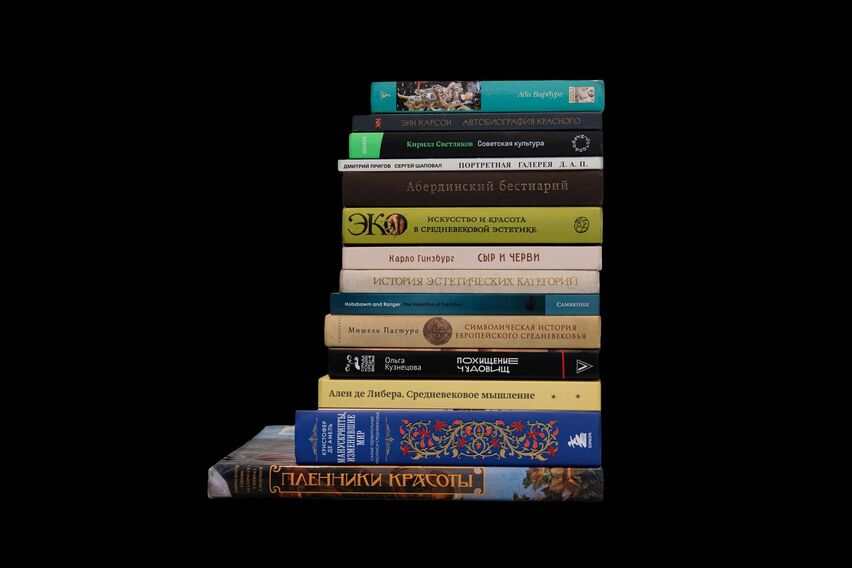
Photo: Anya Todich
Undark Ages: Tales of Medievalism and Academia’s juxtaposition of works by contemporary artists and by masters of past centuries questioned the widespread opposition between a “radiant” Antiquity and the “dark” Middle Ages. However, as Umberto Eco notes in Zametki na polyakh “Imeni rozy” [Postscript to “The Name of the Rose”], our modernity is entirely shaped by a medieval “childhood.” The books in this collection help us better understand intellectual and cultural heritage of past eras that is reflected in our present.
In Istoriya tsivilizatsiy kak kul’turnyy transfer [The History of Civilizations as Cultural Transfer], Michel Espagne proposes that civilizations are defined by the way they interact with other cultures. Using the example of Franco-German intellectual exchanges, Espagne examines the process of transfer—how a text or image changes meaning as it enters another culture.
The authors of The Invention of Tradition, edited by Eric Hobsbawm and Terence Ranger, demonstrate how many “ancient” customs were in fact constructed in the nineteenth and twentieth centuries as responses to contemporary crises. The Scottish kilt and clan tartans, for example, prove to be not a transhistorical tradition of the Highlanders but a creation of an eighteenth-century English industrialist Quaker; the product of the Romantic imagination of Walter Scott’s era. Such “invented traditions” require ritual repetition to conceal their novelty. This provides a key to understanding the first chapter of Undark Ages, which examines the reproduction of images of Antiquity in art history.
Such transformations can be traced in the catalogue of the project Plenniki krasoty: russkoe akademicheskoe i salonnoe iskusstvo 1830–1910-kh godov [Captives of Beauty: Russian Academic and Salon Art of the 1830s—1910s]. For a long time, academic painting was overshadowed by the socially charged realism of the Peredvizhniki, however, this catalogue foregrounds the care and mastery with which Russian artists created their own dream of “Rome.” We learn that Mikhail Vrubel considered salon painters such as Heinrich Semiradsky to be true artists, and mentioned Ilya Repin only “with reservations.”
Literature also served as a space for such constructions. In Dushenka [Dushenka] by Ippolit Bogdanovich, the ancient myth of Cupid and Psyche is relocated to Tsarskoye Selo and transformed into an ironic fairy tale in which the gods behave like aristocrats. Bogdanovich “domesticates” the myth, turning the pathos of antiquity into a gallant joke and preparing the ground for Pushkin’s poetry. Illustrations for Dushenka by Fyodor Tolstoy are now housed in the Hermitage Museum and the State Tretyakov Gallery.
In the twentieth century, the “dialogue with Antiquity” acquired a state-wide scale: the canon became an instrument of total design. In Sovetskaya kul’tura. Ot bol’shogo stilya do pervykh reyvov [Soviet Culture: From the Grand Style to the First Raves], Kirill Svetlyakov combines analysis of architecture, music, and everyday life to trace the cultural transformations that led from [early] Soviet/state? monumentality to the underground practices of unofficial art. Raves held at the VDNH in the early 1990s are interpreted as reflections of the cosmic aesthetics of the Khrushchev Thaw, within the context of Stalinist Empire style.
The works by artists of Timur Novikov’s “New Academy” displayed at the Undark Ages exhibition radically reinterpreted academic ideals, using them as a language of conceptual resistance to the era of postmodern irony. The moment of the collapse of the ideal is captured by Alexei Losev and Vyacheslav Shestakov in their foundational Istoriya esteticheskikh kategoriy [History of Aesthetic Categories]. The authors show how the beautiful, the sublime, the tragic, the comic, and the ugly were formed and transformed from antiquity to the twentieth century. The concept of beauty held fundamentally different meanings for Plato, Thomas Aquinas, and Kant, while in the Middle Ages, ugliness was regarded as a necessary counterpart for understanding the beauty of creation.
In Iskusstvo i krasota v srednevekovoy estetike [Art and Beauty in Medieval Aesthetics], Umberto Eco demonstrates that the Middle Ages were literally obsessed with beauty—of light, numbers, and the organism—possessing a developed, refined, and internally consistent theory of the beautiful. For medieval people, beauty was not merely aesthetic but a property of being itself, synonymous with the good—from the metaphysics of light in Pseudo-Dionysius the Areopagite to the doctrine of proportion in Thomas Aquinas. Eco notes in particular that it was not shades of color that were valued but intensity: “bright” and “red” were synonymous with beauty, while dullness was considered imperfection.
In Srednevekovoe myshlenie [Medieval Thinking], the French philosopher Alain de Libera argues that the figure of the “intellectual” was born not in the modern era but in the age of scholasticism. Knowledge emerges as the product of complex translations and sometimes mutually exclusive ideas from Latin, Arabic, and Jewish traditions. Scholars transformed philosophy from a body of knowledge into an “existential project,” complete with its own challenges and crises, such as the ideological and institutional conflicts surrounding the ideas of Averroes, which came from Arabic philosophy.
In the classic Osen’ Srednevekov’ya [The Autumn of the Middle Ages], Johan Huizinga describes the atmosphere of the late medieval Netherlands: “When the world was five centuries younger, all the events of life took on forms much more sharply defined.” Rituals, festivities, chivalric gestures, and images of decay and luxury begin to take on an almost autonomous life, turning into theater: nearly every event was shaped by strict rules of ritual and etiquette, combining naturalism with refined decorativeness.
In a remarkable example of microhistory, Syr i chervi [The Cheese and the Worms], Carlo Ginzburg reconstructs the cosmos of Menocchio, a miller accused of heresy in the sixteenth century. reconstructs the worldview of Menocchio, a sixteenth-century miller accused of heresy. His interrogations by the Inquisition reveal how authoritative texts and sermons were refracted through individual consciousness, producing an original cosmology in which the world emerged from chaos as cheese forms from milk, with angels arising like worms in the cheese.
Another important source shaping the image of the surrounding world was the development of information networks. In Izobretenie novostey [The Invention of News], Andrew Pettegree studies the evolution of Europe’s communication systems from oral to printed forms. He describes the emergence of a media market of rumors, manuscript newsletters, and publishing networks, where attention, trust, and speed became commodities and objects of competition. A telling example: the Fugger merchants maintained a private postal system that operated faster than the state one and sold subscriptions that became a marker of high status.
One of the most compelling accounts of how cultural memory is formed can be found in the works of art theorist Aby Warburg. The collection Velikoe pereselenie obrazov [The Great Migration of Images] shows that the history of artistic practices is a fascinating science of the collective unconscious. Ancient gestures of passion or grief—so-called "pathos formulas“—migrate from pagan sarcophagi into Renaissance painting, and from there into newspaper imagery and modern advertising. Warburg’s approach explains why the same visual formulas are reproduced across millennia, transcending borders and languages. He even visited Pueblo communities in the United States to study snake rituals in search of parallels with the ancient cults of the maenads. His unfinished project Mnemosyne Atlas—vast panels with photographs of artworks, advertising posters, stamps, and newspaper clippings arranged side by side without hierarchy or chronology—became both the culmination and material manifesto of his method, anticipating many practices of contemporary curating. As Ilya Doronchenkov writes in the preface: “Perhaps he sought, in a literal sense, to ‘map’ the topoi preserved in the European collective memory, to trace their internal connections, to understand how consciousness constructs images, sometimes reviving the outlines of something that once existed.”
In short, this book collection reminds us that history is a changing world of ways of seeing, understanding, and being. Ultimately, such an approach ultimately sees us learn less about the past than about ourselves.