The selection of books below includes historical and theoretical works on theatre, as well as publications exploring the dramatic arts.
Theatre. Book Collection
- Date:
- from
4 Dec 2024
- Age restrictions
- 18+
T
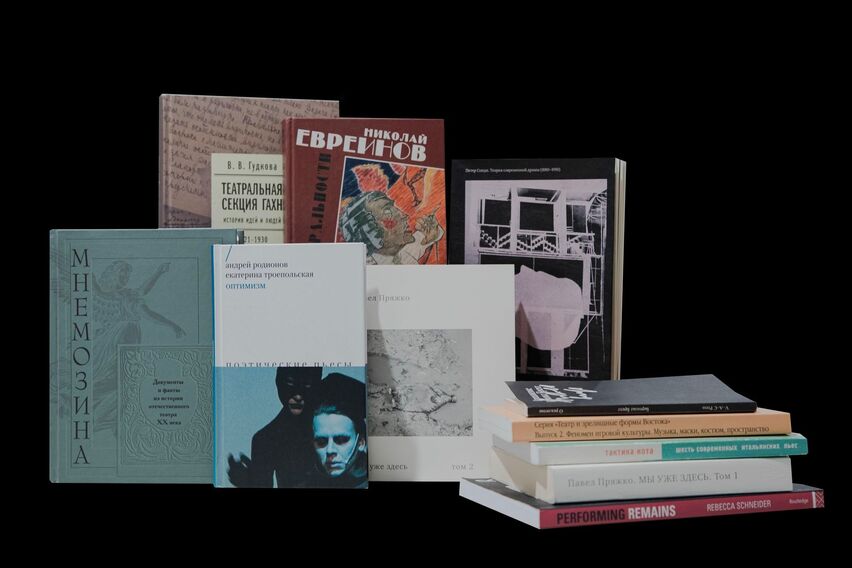
Photo: Anya Todich
This book collection on theatre has been gradually assembled since the opening of
History
Compiled by the theatre historian Alla Mikhailova, the album Mejerxol`d i xudozhniki [Meyerhold and Artists] (in Russian) explores Vsevolod Meyerhold’s explorations and experiments in theatrical imagery. The album brings together sketches for stage sets and costumes by the various artists Meyerhold worked with, setting them alongside critics’ impressions of performances. A separate chapter is dedicated to the director’s architectural aspirations, and includes the plans for the Vsevolod Meyerhold State Theatre, which became a theatre for promotion of state agenda and agitation.
The almanac Mnemozina. Dokumenty` i fakty` iz istorii otechestvennogo teatra XX veka [Mnemosyne. Documents and Facts from the History of Russian Theatre of the 20th Century] (in Russian) is a collection of archival documents—unpublished plays, diaries, and correspondence. On the pages of this almanac, one encounters the directors Sergei Eisenstein and Vsevolod Meyerhold, the actresses Alice Koonen and Vera Komissarzhevskaya, and the theatre critics and theorists Nikolai Evreinov and Michael Chekhov. Each document is accompanied by commentary and notes.
In Teatral`naya sekciya GAXN: istoriya idej i lyudej 1921–1930 [The Theatre Section of GAKhN: A History of Ideas and People, 1921–1930] (in Russian), Violetta Gudkova explores the formation and work of the Russian Academy of Artistic Sciences’s Theatre Department. Created in the 1920s, this department was the origin of Russian theatre studies—it was where academic discussions took place and the theoretical directions of theatrical art were defined. Closer to the 1930s, the institution was closed. Ideologically, it did not correspond with the new state’s conceptions of theatre.
The collection Teatr i zrelishhny`e formy` Vostoka. Fenomen igrovoj kul`tury`. Muzy`ka, maski, kostyum, prostranstvo [Theatre and Spectacle Forms of the East. The Phenomenon of Play Culture. Music, Masks, Costume, Space] (in Russian) examines musical traditions, stage space, and actor’s costumes in the theatrical practices of the East. It includes articles on Japanese puppet theatre, on decorations and garments in Tibetan ritual performances,on masks in Thai theatre, and on the Peking Opera. As well as original articles, the collection includes the translated chapter “On Dance” from Medjid Rezvani’s Theatre and Dance in Iran.
Theory
In the early twentieth century, the theatre practitioner and theorist Nikolai Evreinov developed an experimental system for the “theatricalisation” of life in his works Vvedenie v monodramu [Introduction to Monodrama], Teatr kak takovoj [Theatre as Such], and Teatr dlya sebya [Theatre for Oneself] (in Russian). Evreinov elevates Shakespeare’s aphorism “All the world’s a stage” to an absolute. People, according to Evreinov, enact performances daily—in their everyday gestures and phrases, in grand celebrations, in children’s role-playing games, in folk rites. Theatre for Evreinov is not just a performance on stage, it is a philosophy of life.
The German theorist and historian Peter Szondi’s Teoriya sovremennoj dramy` (1880–1950) [Theory of Modern Drama (1880–1950)] (Russian edition) has a tripartite structure. Szondi begins the work by exploring the “crisis of drama” that took place at the end of the nineteenth century. Szondi then examines “attempts to save” contemporary drama through the rethinking of dialogue, experiments in form, and use of existentialist themes. His work concludes by assessing the"attempts at a solution" to the dramaturgical crisis: expressionist dramaturgy, the political theatre of Piscator, and the epic theatre of Brecht.
In the collection of essays O realizme [On Realism] (Russian edition), the German director, playwright, and theorist Bertolt Brecht reflects on how to express truth in works of art and on what realism is in twentieth-century theatre. In “Five Difficulties in Writing the Truth,” Brecht concludes that to be truthful, one needs courage, wisdom, skill, judgment, and cunning. To follow these commandments, according to Brecht, is to write realistically. In “Notes on the Realistic Mode of Writing,” Brecht considers realism as an artistic means. For a writer, to think realistically is to learn from reality in order to reflect it.
Performing Remains: Art and War in Times of Theatrical Reenactment is a collection of essays by the American theorist Rebecca Schneider. The collection reflects on performance, theatre, and historical reconstruction. The starting point of Schneider’s work is the experience of reenactment. Using this term, Schneider examines historical reconstructions of American Civil War battles, the activities of the avant-garde theatre company The Wooster Group, and the methods and possibilities of archiving “live” art—performance and theatre.
Drama
My` uzhe zdes` [We Are Already Here] (in Russian) is a collection of plays by Pavel Pryazhko. The play that gives the collection its title, We Are Already Here, describes the life of colonisers of Mars, but is is not a sci-fi adventure, , as it might appear at first glance. The characters of We Are Already Here are bored, long for home, and hide from existential questions. Another play in the collection, Cannon Fodder, articulates every action of its characters, who mechanically inform the audience as to what they are doing and where they are going, allowing Pryazhko to accentuate the habitual gestures that typically go unnoticed in everyday life.
Translated into Russian for the first time,the Taktika kota [The Cat’s Tactics] (Russian edition) anthology of contemporary Italian drama brings together stylistically different plays. Bus Stop by Adriano Sconocchia is an Italian variation on Beckett’s tragicomedy Waiting for Godot, while As Good as It Gets by Giancarlo Loffarelli is commedia dell’arte, theatre within theatre, which blurs the line between performance and real life. Giampiero Rappa’s Ransom dramatises the collision of the personal and the political. A group of young people kidnap a politician’s daughter, but personal relationships between the kidnappers and kidnapped gradually improve.
The French writer Patrick Bouvet’s Na meste naxozhdeniya [In Situ] (Russian edition) was used in the performance Zero Risk Does Not Exist, which was staged by the Cultural Capital of the Volga Region Foundation and the Volga branch of the NCCA in Nizhny Novgorod. This fragmentary, avant-garde account of a totalitarian society reflects the paranoid consciousness. Interestingly, in the final staging of Bouvet’s monologue a video shot by the renowned Nizhny Novgorod video-artist duo — the PROVMYZA collective — was used.
Optimizm [Optimism] (in Russian) is a collection of poetic plays by the poets and playwrights Andrey Rodionov and Ekaterina Troepolskaya which combines lyricism and acute social humor. In Happiness Is Not Far Off, capital-city contemporary art figures try to find a common language with their regional counterparts. In Project “Swan,” the state establishes the poetic syllable as the only permitted form of language and, in these absurd conditions, forms a commission on poetic norms to certify the future citizens of this state.