The World in a Single Nest is a joint project between
The World in a Single Nest: Following the Way of Tagore. Introduction to the Exhibition
- Age:
- Type:
- Age restrictions
- 12+
T
In 1913, Tagore was the first non-European to receive the Nobel Prize in Literature for his collection of poems Gitanjali (“Sacred Songs”), and two of Tagore’s poems went on to become the national anthems of India and Bangladesh. However, Tagore’s significance is measured not only by his rich and diverse creative legacy. He is also remembered for his social activism, which played an important role in the cultural and political revival of India as it moved towards independence.
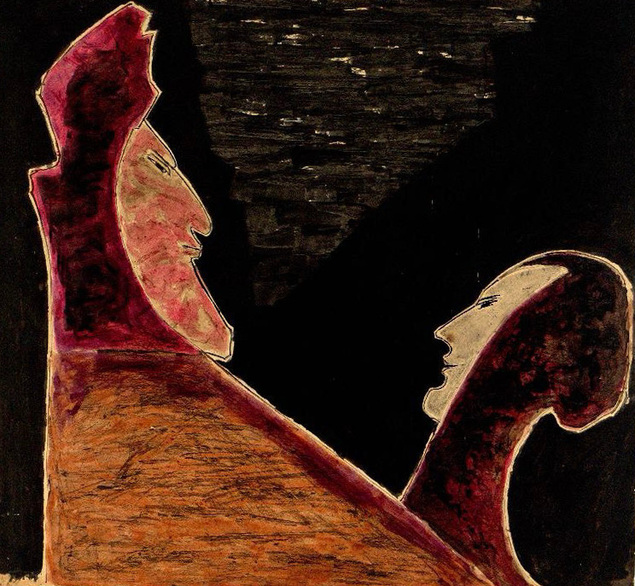
Rabindranath Tagore. Untitled (“A Couple Looking at Each Other”), ca. 1929–1930
Visva-Bharati University, founded in 1921 in Santiniketan, Bengal, is the most complete and enduring embodiment of Tagore’s ideas. It is also the focal point of the exhibition at
The university included the Kala Bhavana art school, which combined crafts with agriculture in a holistic vision of man and nature, bringing together artists, scientists, and ordinary farmers, and engaging in dialogue with the traditions and contemporary trends of many countries. Some of the most significant artists of Indian modernism—Nandalal Bose, Ramkinkar Baij, and K.G. Subramanyan—taught and worked in Santiniketan at Tagore’s invitation.
At the age of 67, Rabindranath Tagore himself turned to visual art. Tagore the artist, to whom this exhibition is dedicated, left behind more than 2500 paintings and graphic works, most of which are kept in his former home in Santiniketan, which is now a museum dedicated to his legacy. The works are displayed at
Tagore’s art was the embodiment of Indian modernism, which, as in Europe and Russia, began with an avant-garde rejection of the canons (for colonial India, these were the canons of Western academicism, as cultivated in Britain through the eighteenth and nineteenth centuries). Tagore’s modernism was simultaneously rooted in the ancient artistic traditions of his home region and open to dialogue with the art of both East and West.
The desire for internationalism was also reflected in numerous journeys, which Tagore undertook between 1912 and 1932, including a visit to the USSR. The
Many of Tagore’s ideas, expressed in his journalistic writings, essays, and speeches, sound very modern. His views on such seemingly diverse phenomena as pedagogy and art education, internationalism, collective creativity, nature and agriculture form a coherent philosophy. These themes became the leitmotifs of the exhibition The World in a Single Nest, and they are echoed in the works of contemporary artists from different countries. Engaging in dialogue with Tagore’s philosophical and political reflections on, for example, ecology or globalisation, these works show that he remains a highly relevant social thinker even today.