The exhibition invites us to look, in the manner of a genealogical investigation, at the three classical painting genres.
Still Life. Portrait. Landscape. After Genre. Introduction
- Type:
T
The genres of still life, portrait, and landscape not only defined ways of depicting the world in different periods but also anticipated many contemporary forms of visual communication from advertising to video games, computer-generated imagery, and even the form of digital self-expression that is most widespread today—the selfie. Each of the exhibition’s three sections uses a different method and different criteria for selecting works, from a comparative analysis of works of different periods and a juxtaposition of digital content and design products, to a classic display of painterly self-portraits by one of the most important artists of the last century, Kazimir Malevich.
The still-life, portrait, and landscape genres constitute multi-layered constructs at the intersection of different fields of knowledge. The still life reflects the history of commodity exchange and how the imagery of things has been constructed, taking things both as symbolic units of political-economic or ideological discourse, and as objects of consumer desire. The portrait, which once affirmed the value of the individual, now serves as a universal model for the creation of a virtual identity. The landscape records how the relationship between people and nature has changed from the Industrial Revolution to the era of digital omnipotence. The principal aim of all three sections is to ascertain how art and visual culture reflect the processes, which together shape our complex picture of the contemporary world.
The concept of genre remains one of the most useful points of reference for historiographical representation of works of art, whether in an exhibition or a research text, and whether addressing a general or a specialist audience. Art historians use genre as a taxonomic or investigative tool through which to describe both the social reception of art and patterns of cultural production in the past.
By the turn of the eighteenth and nineteenth centuries, genre had become a key element in a system of aesthetic knowledge that encompassed the panorama of reality in all its variety. However, through the nineteenth century the topic of genre gradually became shrouded in ambivalence. On the one hand, works of art were classified by their genre, whilst in literature, genre became the base criterion for determining the semantic essence of a text. On the other hand, it was precisely during this period that concepts began to emerge, which challenged rigid genre boundaries and highlighted their limiting nature. Established artistic canons were eroded and the old forms of organisation of artistic thought were increasingly viewed as redundant.
The Modernist era saw even greater paradigm shifts and transformations in theoretical discourse. The rejection of figurativeness and the critique of mimesis—the imitation of reality—led not only to a change in visual language but also to a rethinking of the role of art in social and political life. Classification by genre—the cornerstone of pre-modern art history—was gradually marginalised in discourse about art. Artists themselves, and even entire art movements, ceased to identify themselves within the logic of genre. The focus nowadays is on medium, format, thematic framework, or the artist’s interpretation of a particular methodology in response to expectations of the public and the historical era.
Nevertheless, genre, as a key aspect of visuality, is by no means extinct. Indeed, it is apparent in the diversity of digital content in the twenty-first century. In the contemporary world, where the flow of visual images grows by the minute, a return to a genre-based perspective may offer new strategies for organising and making sense. After weathering an epistemological crisis, genres are condensing in the space of contemporary culture, enabling the formation of a new understanding of the anthropogenic universe as physical and digital realities become increasingly intermixed.
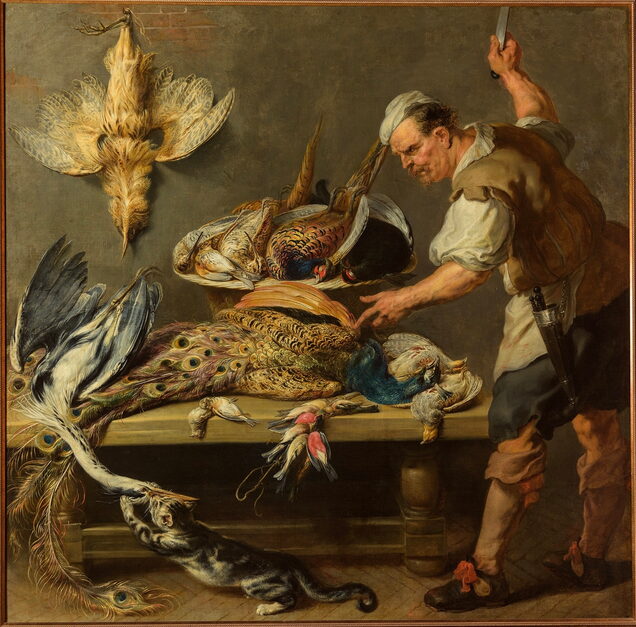
Jan Boeckhorst. Frans Snyders. Cook in the Larder, 1630s. State Hermitage Museum
The opening section of the exhibition is devoted to still life, which emerged as a distinct genre in the works of seventeenth-century Dutch and Flemish artists. The emergence of still life as a genre owed much to the transition from feudalism—the socio-economic and political system of the Middle Ages—to a quite different form of economic relations, namely capitalism, which continues to shape the development of human civilisation in our day. The transformation of market relations, along with industrial production, colonial conquest, and the cultural expansion that followed it, the advance of international logistics, and industrial methods of resource extraction—such was the historical and political-economic context, in which still life emerged as an artistic phenomenon.
The conceptual core of this section is an analysis of the ontological status of the object in the era of late capitalism, when human life has become permeated by ubiquitous mass media, as conceptualised by the French philosopher, Jean Baudrillard. Since the 1960s, Baudrillard described an essential transformation in the relationship between people and objects, where objects lost their utilitarian function and were transformed into a system of signs, which he called a “hyperreality”, structured by the interaction of virtual entities, which he called “simulacra”. The consumption of these symbolic units—avatars of real objects—has become one of the main activities of modern man.
The narrative in this section unfolds in two directions. The first considers the existence of objects in public and private spaces: works by past masters and by contemporary artists show how objects become metaphors for understanding the surrounding world, taking on a new role as advertising images, ideological messages, and repositories of personal or collective memory. The second direction looks at a state of society where objects, by stimulating consumer desire, come to control the thoughts and actions of people.
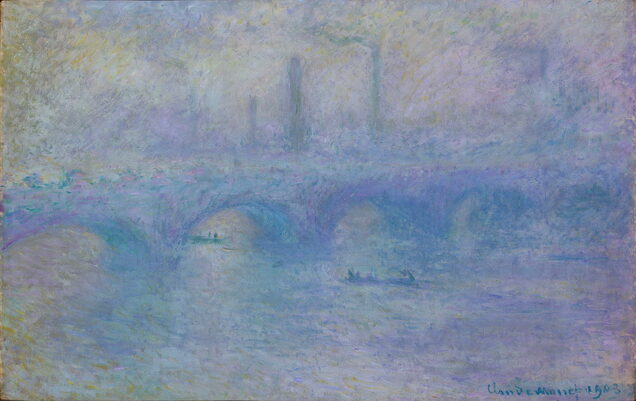
Claude Monet. Waterloo Bridge. Effect of Fog, 1903. State Hermitage Museum
The next section, devoted to landscape, explores the evolution of the landscape genre from the Industrial Revolution to the emergence of modern data centres and digital platforms. The works show how traditional conceptual and visual perception of the natural landscape has been gradually transformed by technology, extraction, and, more recently, by digitalisation and gamification. Digitalisation has turned landscape into a place where the real and the virtual intertwine. Gamification has introduced interactivity and game mechanics: the landscape has become a space for actions and experiments regulated by algorithmic control. Extraction—the relentless exploitation of the earth’s subsoil—is perhaps the central motif of the section. Every pixel of the digital world is powered by the natural resources of the real world, and the processes of their extraction and processing have a major impact on the real world. So, from the impressionist haze of the nineteenth century, we arrive at generated images where physical and virtual reality are both present.
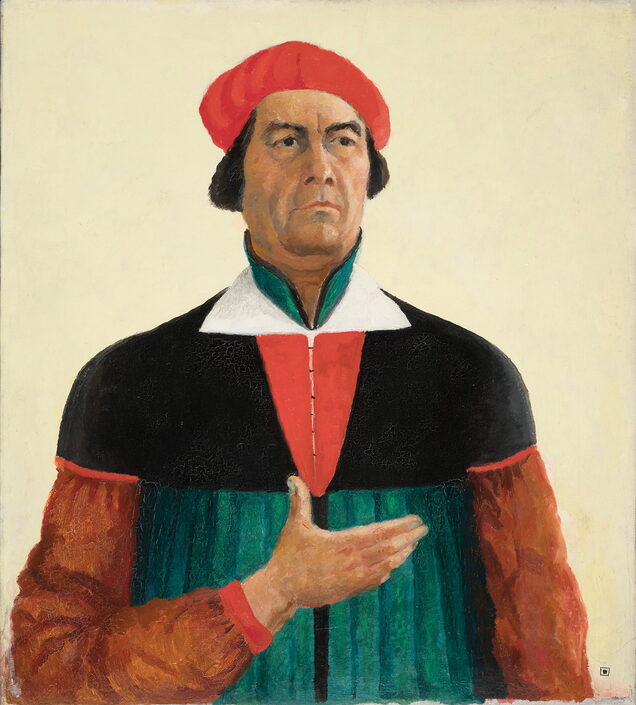
Kazimir Malevich. Self-Portrait (The Artist), 1933. State Russian Museum
The portrait section concludes these reflections on the aesthetic understanding of the world through visual art genres, looking at the radical artistic gestures by which masters of the last century generated images of themselves. The displayed works include five self-portraits by Kazimir Malevich and a replica of Andrei Monastyrski’s object, Finger.
For the great avant-garde artist of the first part of the century, the self-portrait genre was not about self-admiration. It was a space for artistic experimentation and a means of affirming the role of the modernist artist as creator and architect of a new world. But while Malevich still worked within the painterly traditions of his time—albeit manipulating them at will—Monastyrski, by contrast, erased all boundaries between artistic expression and life, the viewer and the artist, the face and its reflection. Finger literally pokes through these boundaries. Something similar is happening in our age of digital narcissism: social media are filled with “selfies”, and the entire world becomes an endless backdrop for an egocentric narrative, governed by the laws of demonstration, approval, and consumption. The self-portrait has today become the true “genre of genres”: it transforms the sunset, worthy of a landscape painter’s canvas, or the dinner table, worthy of a still life, into instruments of self-affirmation.