A book collection dedicated to the multifaceted nature of performance.
Performance. Book Collection
- Age restrictions
- 18+
T
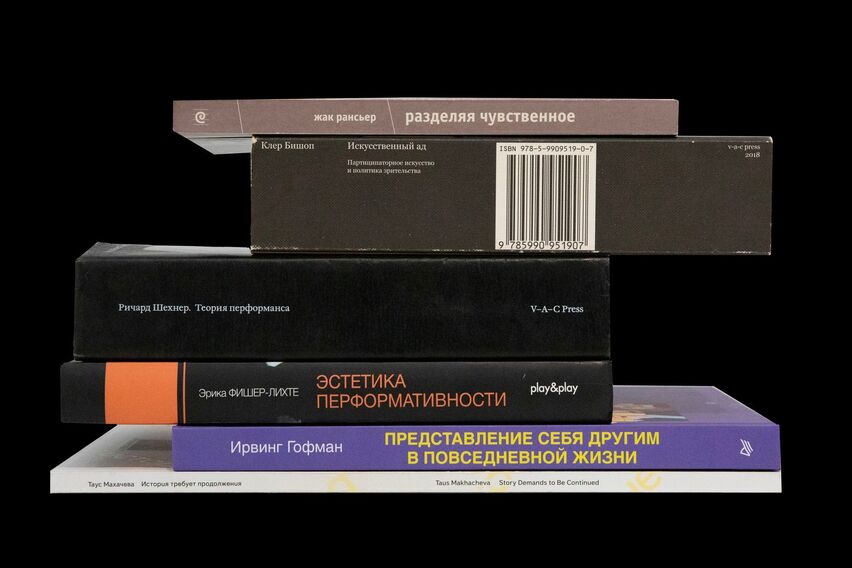
Photo: Anna Zavozyaeva
Though the word is encountered quite frequently, a concise and all-encompassing definition of “performance” is difficult to come by. Academic literature, journalism, casual conversations—the use of the word “performance” in various contexts lends the art historical term a polysemy that spans “execution,” “fulfillment,” “presentation,” “spectacle,” “productivity,” and “play,” to name only a few. The works of philosophy, anthropology, and art criticism brought together in this collection propose an understanding of performance as a collective-dramatic and social statement.
Performance and Play
One of the main and most striking elements of performance is the blurring of the boundary between the artist’s intention and the public’s experience. In her foundational study E`stetika performativnosti [The Transformative Power of Performance] (Russian edition), Erika Fischer-Lichte summarises this property as “spectacularity,” a quality of spectacle that unites the spectator’s experience and the author’s intention into a single whole. In turning to performance, artists violate “common sense” and intervene in the established contexts they coexist in with the audience—a public not always ready to part with notions rooted in artistic and social traditions.
Fischer-Lichte writes about the ritual quality of performance, and her reflections align with the theory of performance set forth by Richard Schechner in his Teoriya performansa [Performance Theory] (Russian edition)—in this book, Schechner describes the connection between Western European dramatic theatre and the everyday rituals of indigenous peoples throughout the world. Performance is deeply rooted in the playful, corporeal, and immersive character of rites, which at once reflect generally accepted rules and critique them.
The collision of authorial and spectatorial attitudes that occurs during a performance was termed the “distribution of the sensible” by the French philosopher Jacques Rancière in his eponymous book Razdelyaya chuvstvennoe [The Distribution of the Sensible] (Russian edition). The spectacularity and interactivity of performance trigger a special process in which participants discover both common and diverging views on the nature of the aesthetic and the sensible. The establishment of these relationships and the beginning of a dialogue is where one encounters the “social function” of performance.
Performance and Social Representation
“Effectiveness,” “productivity,” and "presentation“—the various meanings of the word performance emphasise its social aspect: actions and results become significant when they can be shown to others, evaluated, and compared with expectations. The theatrical nature of performance includes a collective dimension which the humanities can help to elucidate. Erving Goffman’s sociological study, Predstavlenie sebya drugim v povsednevnoj zhizni [The Presentation of Self in Everyday Life] (Russian edition), proposes a view of everyday interaction through the concepts of role, stage, and audience. According to Goffman, the individual, like a participant in a theatrical production, “directs” their public image and regulates the impressions they produce on others. Sheila Fitzpatrick’s historical study Tear off the Masks! Identity and Imposture in Twentieth-century Russia shows how a person’s reconciliation of their public image with the strict normative ideas that dominate society can alter culture and everyday life. Francesca Granata’s book E`ksperimental`naya moda. Iskusstvo performansa, karnaval i grotesknoe telo [Experimental Fashion: Performance Art, Carnival, and the Grotesque Body] (Russian edition) shows how costumes and intentionally grotesque forms of clothing are capable of setting and changing social roles and generally accepted ideas about them.
This aspect of performance allows us to consider the cultural and communicative significance of art. Artists working with performance often address little-discussed subjects, drawing viewers’ attention to them and asking them to reconsider or develop their views of them. The zine published by the VASYABEGI project (in Russian) could be cited as an example. VASYABEGI was an anonymous interdisciplinary programme for young people struggling with self-identification. Throughout meditations, conversations, psychosomatic exercises, and public performances, participants learnt a mindful attitude towards their bodies and identities. The project became a “laboratory of self-knowledge,” in which the “archetype of the modern Russian teenager” was investigated through collective choreographic practices.
The catalogue Istoriya trebuet prodolzheniya: vy`stavka Taus Maxachevoj [History Demands to Be Continued: Taus Makhacheva’s Exhibition] (in Russian) is also an invitation to interpretation and self-knowledge. The collective memories and visual mythologies of local cultures are spectral, ghostly, and the modern viewer can learn about these phenomena through the language of contemporary art. Regardless of a viewer’s identity, this position is “performative” and representative for various communities that feel a lasting interest in the collective history they share with their families and neighbours. Claire Bishop’s Iskusstvenny`j ad [Artificial Hells] (Russian edition) is dedicated to equal dialogue between the author and the public, as well as to the conditions that make such a dialogue possible—this work is a handbook for those interested in the theory and history of participatory art. As with “performance,” it is worth noting the polysemous nature of the word “participation.” After all, it is precisely an empathetic, equal relationship that is the condition of performance—of play, spectacle, and the “presentation of self to others.”