This book collection, compiled by medievalist Polina Pilyugina to coincide with the Undark Ages: Tales of Medievalism and Academia exhibition at
How to Invent the Middle Ages: Recommended by Polina Pilyugina
- Age restrictions
- 18+
T
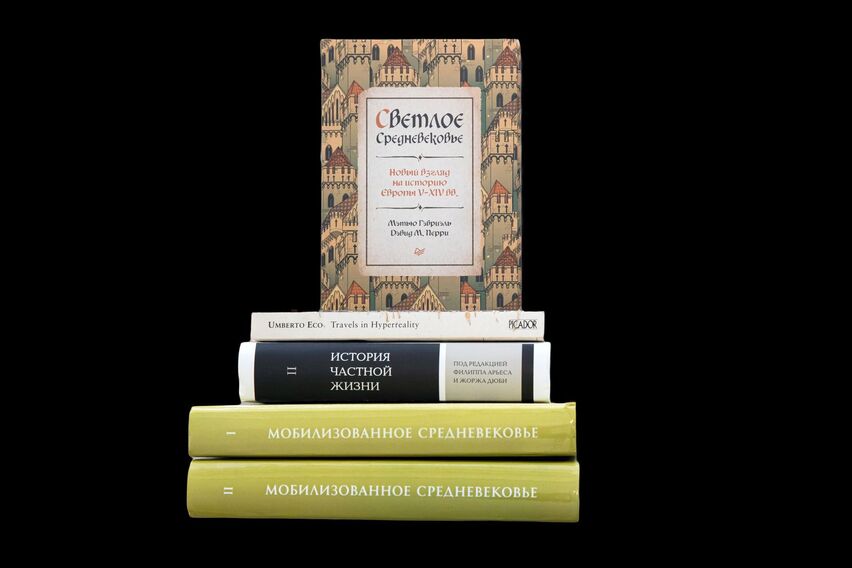
Photo: Anya Todich
Like the exhibition it accompanies, this book collection is divided into two parts: the first includes studies of the Middle Ages themselves, the second focuses on the “afterlife” of this historical period. We encounter images of the Middle Ages everywhere: in cinema, computer games, historical novels, fantasy works, memes, school textbooks, and museums. On the one hand, the period appears to us as a familiar set of stereotypes—witches, beautiful ladies and knights, the plague, and poor sanitary conditions, to name only a few. On the other hand, the realities of this historical period are distant from us and difficult to understand—notably the social structure of the Middle Ages, as well as the self-perception and worldviews of the people who lived then.
The books in the first part of this collection ask us to look at this contradictory period differently and question the things we think we know about it for certain. Aaron Gurevich’s classic work, Kategorii srednevekovoj kul`tury` [Categories of Medieval Culture] (in Russian), makes phenomena that seem strange and absurd from our point of view understandable, bringing to light the anxieties and experiences hidden behind them. The work also explores subjects such as how time was perceived in the Middle Ages, the role played by the law in shaping the world order, and ideas about wealth and labor. No less of a classic is Philippe Ariès’s Istoriya chastnoj zhizni. Tom vtoroj. Evropa ot feodalizma do Renessansa [A History of Private Life. Volume II: Revelations of the Medieval World] (Russian edition), which addresses subjects we are not accustomed to associate with the Middle Ages such as personal space, intimacy, and the birth of individuality. Both works allow for a view of the Middle Ages not simply as a history of royal dynasties, crusades, and wars, but as a time full of diverse and volatile life.
In a similar vein, Svetloe Srednevekov`e. Novy`j vzglyad na istoriyu Evropy` V–XIV vv. [The Light Ages: The Surprising Story of Medieval Science] (Russian edition) challenges the idea of the so-called “dark ages” as a period of superstition, scientific delusion, and decline—a common view in popular culture. The authors of the book show how active the intellectual life of the period was and demonstrate the mechanisms of cultural development. They also expand the traditional geographical boundaries of the era through their analyses of Baghdad, Marrakesh, and Cairo, challenging the view that medieval societies were isolated from one another and rarely interacted with other cultures.
The second part of this collection includes works dedicated to medievalism, that is, to images of the Middle Ages in post-medieval times. It seeks to answer questions that may arise in reading the books of the first part. How and why were certain images of the Middle Ages created? Why did they remain popular for centuries? The first book in this part of the collection is Umberto Eco’s essay “The Return of the Middle Ages,” published in the Travels in Hyperreality collection. Eco was among the first to draw attention to the prevalence of medieval images in the popular culture of his time and proposed his own conceptualization of the phenomenon. Eco’s work provided an impetus for the development of medievalism studies around the world, and it is often through this text that acquaintance with the field begins.
A good example of modern medievalist research is Olga Togoeva’s book “Deva so znamenem”. Istoriya Francii XV–XXI vv. v portretax Zhanny` d’Ark [“The Maid with the Banner”. The History of Fifteenth—Twentieth Century France in Portraits of Joan of Arc] (in Russian). In this work, Togoeva examines the history of the formation of one of the most well-known medieval symbols—the Maid of Orléans—under the influence of social processes, political events, and the religious and social problems of France. This work is a clear expression of one of the main theses of medievalism studies: images of the Middle Ages tell us more about the era and society that produced them than they do about the Middle Ages themselves.
Eastern Europe and Russia rarely fall into the field of vision of medievalist researchers, who are traditionally more focused on Western European material. The two-volume collection Mobilizovannoe Srednevekov`e [The Mobilised Middle Ages] (in Russian), published by Saint Petersburg University Press, seeks to correct this: the first volume examines the connection between medievalism and national identity in Central-Eastern Europe and the Balkans, while the second is dedicated to the phenomenon of medievalism in Russia.
Unfortunately, specialised studies in Russia are only just gaining in popularity, and a large corpus of foreign literature on the subject has not yet been translated into Russian. One would, however, like to believe that the exhibition Undark Ages: Tales of Medievalism and Academia will be an important step in this process.
Author
Polina Pilyugina is a historian, medievalist, and doctoral student at the School of Philological Sciences at HSE University. She is a graduate of the “Medieval Studies” masters programme at HSE University. Her lecture series “Medievalism: The Middle Ages in Contemporary Culture” won the “Inostranka” lecture hall’s open competition in 2023.