The autumn of a dictator in exile, filmed as an intoxicating delirium. Russian premiere in the programme The Rebellion of Dreams. Director: Glauber Rocha.
Cutting Heads
- Date:
- 30 Apr 2026,
19:30–21:10
- Age restrictions
- 18+
Registration opens two weeks before the screening.
T
Somewhere in the mountains of Latin America, a man known as Díaz II raves in his own castle. Once the populist dictator of a country called Eldorado, he is now preparing to die—hallucinating scenes from the past, a power that has crumbled, a love long lost. Meanwhile, a mysterious man carrying a sickle is already approaching the castle: through a series of mystical rituals, he is destined to kill the old world so that the earth may give birth to a new one.
Cabezas cortadas
1970, Glauber Rocha
Brazil—Spain
94 minutes, Portuguese with Russian subtitles
Starring: Pierre Clémenti, Francisco Rabal, Rosa Maria Penna, Marta May
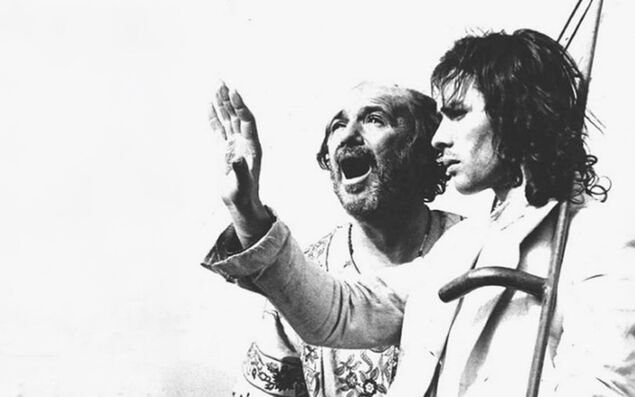
Shot from Cutting Heads, 1970
As a radical drama of political concepts this has few equals in cinema of the period, certainly none on the scale Glauber is working on.
— Filipe Furtado, Anotações de um Cinéfilo
In Cutting Heads—a film one critic bluntly described as "a funeral in images and sounds"—Rocha demonstratively abandons spectacle and narrative coherence in favour of liberating the subconscious: hidden, mesmerising images that, for the director, are far more politically charged than any direct statement. One of them—the dictator’s legs being washed in blood—lingers in the memory for a very long time. The film stands as a vivid embodiment of Rocha’s manifesto The Aesthetics of Dreams, published a year later, which proclaimed a rejection of realism and rationality as the only way to forge a cinematic language truly independent of the powers that be.
This approach indeed allows the director to reach a genuinely visionary level. His musical, symbolically oversaturated film—splicing Freud and Shakespeare, Pasolini and Pinochet—arguably speaks about the nature of power more incisively than many documentaries. But not only about power: one of the recurring ideas throughout Rocha’s cinema, the spiritual animation of the earth, here takes shape as an allegorical cycle of death and resurrection. The land itself longs to die, to carry the tyrant away with it—and then to be reborn. In this light, one cannot ignore the fact that the political exile Rocha made Cutting Heads in Spain, where the land yearned to bury Francisco Franco at long last.