The collapse of Western civilisation through the eyes of an exile from the Third World. Russian premiere in the programme The Rebellion of Dreams. Directed by Glauber Rocha.
Claro
- Date:
- 2 May 2026,
15:00–17:10
- Age restrictions
- 18+
Claro!
1975, Glauber Rocha
111 minutes, Italian with Russian subtitles
Starring: Juliet Berto, Carmelo Bene, Tony Scott, Glauber Rocha
T
It is 1975. America has shamefully withdrawn from Vietnam; Italy, in the midst of its “Years of Lead”, is tightening the screws of political control; Brazil is entering the eleventh year of military dictatorship. World auteur cinema is increasingly retreating from the radical political and formal experiments of the previous decade, and the ideological bonds linking the most forward-looking filmmakers across countries are beginning to crumble. Glauber Rocha, already six years into exile, arrives in Rome to make “a testimony of the colonised about the civilisation of the colonisers.” Accompanied by his lover Juliette Berto, he intrudes on street demonstrations and activist film screenings, provokes tourists, and relentlessly asks questions.
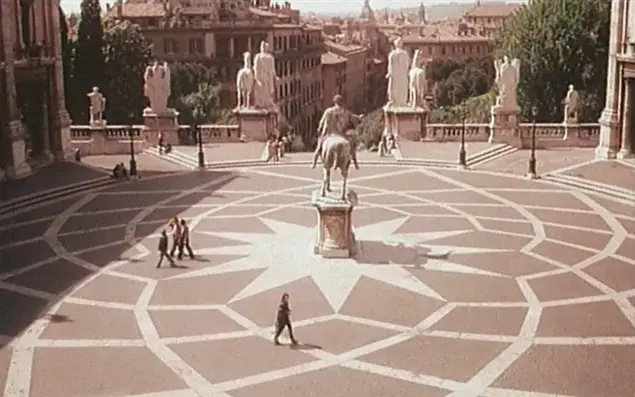
Shot from Claro, 1975
“Claro!”, which was screened at the 1975 Taormina Festival in Italy, has been described by one critic as “a scream that arises from the Third World, runs through the space and time of imperialist oppression and bourgeois decadence, in the exaltation of the struggle for a new world.”
— Randal Johnson, Cinema Novo × 5: Masters of Contemporary Brazilian Film
Today, the fate of Claro!—misunderstood by its contemporaries and unavailable to a wide audience for decades—can be read as evidence of the collapse of the ideals held by the leftist film intelligentsia of the 1960s. Yet for Rocha and his small circle of allies—among them star of the French New Wave Juliette Berto, the legendary avant-garde theatre director Carmelo Bene, and free jazz icon Tony Scott—the spirit of resistance and experimentation was very much alive. Rocha deploys colour-filter effects and the dissonance of sound and image, turns documentary footage into a game and a game into document, shifts between interview and reenactment, and captures the state of the world amid the crises of the 1970s using every means available to a more or less guerrilla mode of filmmaking. Here, for the first and last time, Rocha also entrusts the viewer with revelations from his personal life, where the intimate proves inseparable from global processes.