This collection brings together the most important texts on cinematography held by the
Cinema. Book Collection
- Date:
- from
18 Aug 2025
- Age restrictions
- 18+
T
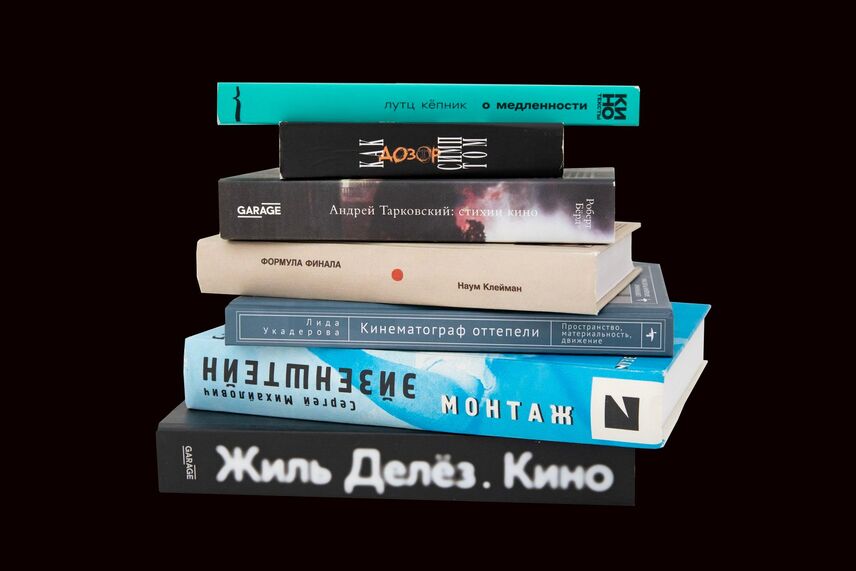
Photo: Anna Zavozyaeva
Theory
The collection opens with the anthology Stroenie fil`ma [The Structure of Film] (in Russian), which includes the canonical text Dialog s e`kranom [Dialogue with the Screen] by Yuri Lotman and Yuri Tsivian. Dialog s e`kranom explains how to articulate and understand the language of cinema. The second part of Stroenie fil`ma comprises film studies and essays by renowned thinkers such as Roman Jakobson, Umberto Eco, Roland Barthes, and Erwin Panofsky. Continuing the theme of analysis of cinematic language, the following book in the collection is Maria Kuvshinova’s lecture series, Kino kak vizual`ny`j kod [Cinema as Visual Code] (in Russian). In these lectures, Kuvshinova explores the dual nature of film—how its material foundations, such as celluloid, light, and the screen, give form to its poetic statements.
For those interested in advanced academic research, we recommend Gilles Deleuze’s foundational work, Cinema (Russian edition). In this study, the French structuralist develops his concepts of the “movement-image” and the “time-image” in cinematography. In Kinematograf. Snovidenie. Psixoanaliz [Cinema. Dream. Psychoanalysis] (in Russian), the philosopher Valery Podoroga examines the psychoanalytic aspects of the viewer’s perception of films. Paul Schrader’s Transcendental Style in Film (Russian edition) and Lutz Koepnick’s On Slowness (Russian edition) theorise the “slow cinema” phenomenon, examining the interplay of cinematic narrative and time.
The following works on Russian cinema address key periods and genres in the history of Soviet and Russian film art. Though they do not proceed in a strictly chronological order, they allow for a general logic of historical development to be observed. The foundational study Kino: organizaciya upravleniya i vlast`. 1917–1938 [Cinema: Management and Power, 1917–1938] (in Russian) provides a detailed account of how revolutionary ideas were manifested on Soviet screens. In the pages of “Plach`te, no snimajte!..” Sovetskaya frontovaya kinoxronika. 1941–1945 [“Cry, but Keep Filming!..” Soviet Frontline Newsreels, 1941–1945] (in Russian), readers can familiarise themselves with the field notes of frontline cameramen. Lida Oukaderova’s Kinematograf ottepeli. Prostranstvo, material`nost`, dvizhenie [The Cinema of the Thaw: Space, Materiality, and Motion] (in Russian) narrates how the changes of the Thaw were reflected in the visual language of cinema—from metaphors of freedom to formal experiments. The phenomenon of documentary filmmaking during the Glasnost period is explored in the anthology Vzry`v: by`tie i by`t dokumental`nogo kino v konce vos`midesyaty`x [Explosion: The Being and Everyday Life of Documentary Cinema in the Late Eighties] (in Russian), while Kinokomediya sovetskogo vremeni: istoriya, zvuchaniya, podteksty` [Soviet-Era Comedy Films: History, Sound, and Subtext] (in Russian) is a reflection on a hallmark genre of its time that served not only as entertainment but as a vehicle for subtle irony directed at social reality.
In Rossijskoe kino v poiskax real`nosti [Russian Cinema in Search of Reality] (in Russian), the film scholar Elena Stishova analyses the new cultural environment of post-Soviet cinema, paying particular attention to key changes in film production, distribution, and audience preferences. An interesting addition to Stishova’s study is provided by Dozor kak simptom [Night Watch as a Symptom], an anthology that uses the examples of the cult Russian films of the 2000s, Night Watch and Day Watch, to demonstrate how to analyse blockbusters using academic tools.
Criticism
This section includes books by two important authors whose texts are as exciting to read as the films they analyse are to watch. Nina Zarkhi’s Pravda stilya [The Truth of Style] (in Russian) is marked by its erudition, detailed analysis, and attention to detail, while Maya Turovskaya’s Geroi “bezgerojnogo vremeni” [Heroes of a “Heroless Time”] (in Russian) is characterized by a distinctive authorial voice, recognisable prose, and resolute judgments.
Beskonechny`j mir idej [The Infinite World of Ideas] (in Russian) is a collection of essays published as part of the Latest Film Theories workshop, which was held at
The section is further enriched by an extensive archive of back issues of the journals Iskusstvo Kino [Art of Cinema] (in Russian, from the 1950s to the 2020s) and Kinovedcheskie zapiski [Film Studies Notes] (in Russian, from the late 1980s to the 2020s), which served as chronicles of both domestic and international cinematic processes.
Personas
Sergei Eisenstein remains a central figure in twentieth-century cinema, and his legacy includes theoretical works alongside films. His books Montazh [Montage] (in Russian), Neravnodushnaya priroda. Chuvstvo kino [Non-Indifferent Nature: The Film Sense] (in Russian), and Neravnodushnaya priroda. O stroenii veshhej [Non-Indifferent Nature: On the Structure of Things] (in Russian) are all considered essential reading for academics and practitioners. The process of working on the film October (1927), which Eisenstein filmed alongside director Grigory Aleksandrov, is meticulously reconstructed in the catalogue “Oktyabr`” v Zimnem [“October” in the Winter Palace] (in Russian). Eisenstein’s personality and artistic path are chronicled in his two-volume autobiography, Yo. Memuary` [Yo: Memoirs] (in Russian), and in Ivan Aksyonov’s biographical sketch, Sergej E`jzenshtejn: portret xudozhnika [Sergei Eisenstein: A Portrait of the Artist] (in Russian). Naum Kleiman, a preeminent film scholar and Eisenstein specialist, comprehensively explores the master’s method in his books Formula finala [Formula of the Finale] (in Russian) and E`tyudy` ob E`jzenshtejne i Pushkine [Studies on Eisenstein and Pushkin] (in Russian). Both works were personally gifted to our library by the author.
Among the more unusual items in the Cinema collection are the anthology E`jzenshtejn dlya XXI veka [Eisenstein for the 21st Century] (in Russian), in which various cultural figures reflect on the director’s contemporary significance, as well as Sergei Prokofiev’s scores for the film Ivan the Terrible. This sheet music edition came to us from the personal library of the late Director of the Pushkin Museum, Irina Antonova.
Alongside these works on Eisenstein are monographs dedicated to other outstanding directors, including Sergei Parajanov, Andrei Tarkovsky, Jean Renoir, Luchino Visconti, Federico Fellini, Barbara Hammer, and Abbas Kiarostami.
Literary Fiction
Another way to understand cinema is to look at how it is understood by authors of short stories and novels, novellas and plays. A variation on the theme of Pier Paolo Pasolini’s film Teorema (1968) is Ali Smith’s novel The Accidental, in which a stranger shatters the established way of life of a respectable family, and one of the leading roles in the narrative is assigned to a camcorder. The prose of Denis Beznosov is filled with cinematic motifs. His novels, such as Territoriya pamyati [The Territory of Memory] (in Russian), as it were “film” reality by means of language—aided by shifts in narrative perspective, a play with close-ups, and an imitation of the cinematic apparatus at work. Beznosov’s prose records both private, everyday moments and large-scale historical processes in which real figures come to life, including directors Fritz Lang and Joris Ivens.