This book collection begins a conversation about the experiences of blind and partially sighted individuals. It includes memoirs, fiction, and periodicals focused on community life, as well as tactile books on art and culture.
Braille and More. Book Collection
- Date:
- from
15 Oct 2024
- Age restrictions
- 18+
T
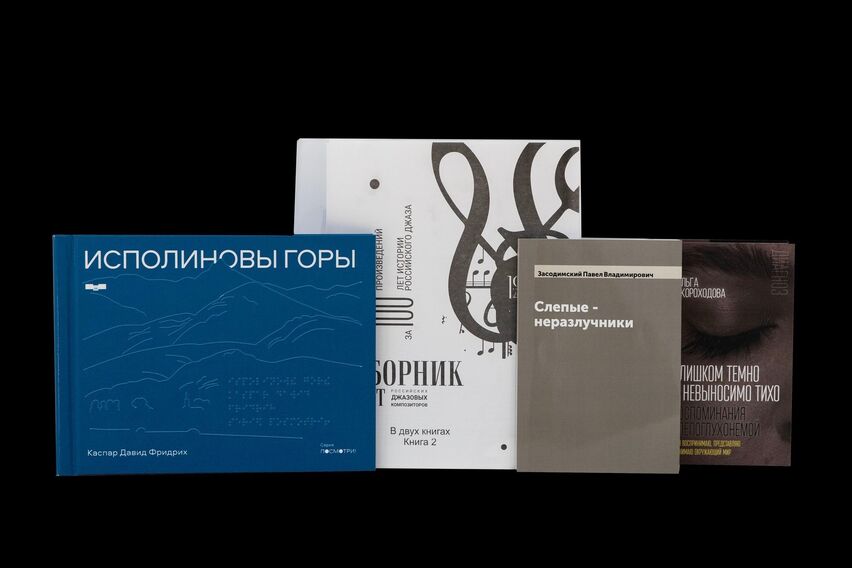
Photo: Vadim Shtein
Researchers typically identify several stages in the evolution of books for blind readers. The process began in France in 1786, when the first attempts to adapt standard fonts for use by the blind in Western Europe and North America were made. By the early nineteenth century, Louis Braille had invented the tactile relief-dot system that would go on to become known simply as ‘Braille.’ A third period began with the emergence of the first relief illustrations. Braille-printed books remain popular to this day, despite the now widespread availability of information in audio formats.
At the
Olga Skorokhodova’s Slishkom temno i nevy`nosimo tixo. Kak ya vosprinimayu, predstavlyayu i ponimayu okruzhayushhij mir. Vospominaniya slepogluxonemoj [Too Dark and Unbearably Quiet: How I Perceive, Imagine, and Understand the World Around Me. Memoirs of a Deafblind Woman] (in Russian) offers insight into the world of a person living with both blindness and deafness. Skorokhodova, a deaf-blind Soviet scientist, built a successful academic career, defending her dissertation and going on to work at one of the research institutes of the Academy of Pedagogical Sciences. Skorokhodova describes her life through touch, smell, vibration, and other sensations. The book concludes with a series of her poems.
Mark Twain famously remarked that the nineteenth century produced only two truly great people, Napoleon and Helen Keller—and he had good reason to make such a claim. Keller’s autobiography, The Story of My Life (Russian edition), evokes neither condescending pity nor tearful sympathy; instead, the reader feels as if they had happened upon a traveler’s notes from a distant, unknown land.
I also enjoy canoeing, and I suppose you will smile when I say that I especially like it on moonlight nights. I cannot, it is true, see the moon climb up the sky behind the pines and steal softly across the heavens, making a shining path for us in the water; but I know she is there, and as I lie back among the pillows and put my hand in the water, I fancy that I feel the shimmer of her garments as she passes.
— Helen Keller, The Story of My Life
Le coeur en braille (A Friend in the Dark, Russian edition) is the most well-known novel by the French writer Pascal Ruter. The story is told from the perspective of Victor, a restless schoolboy who strikes up a friendship with his classmate Marie-Jose. Marie-Jose is an excellent student and cellist, but she guards a secret: she is losing her sight.
Pavel Zasodimsky’s short story Slepy`e-nerazluchniki [The Blind Inseparables] (in Russian), first published in 1899, provides a realistic portrayal of the lives of blind people in Russia during the second half of the nineteenth century. The work tells of the friendship between two blind men—a young man and an elderly one. The “inseparable brothers” live in a church lodge, manage their household, and work side by side.
Since 1924, the monthly socio-political and literary magazine Nasha zhizn` [Our Life] (in Russian) has been published in Russia. In 2002, it became part of the LogosVOS Publishing and Printing Typhlo-Information Complex. Today, it continues to fulfill its mission of providing media support to the All-Russian Society of the Blind and publishing essays, prose, and poetry by the organisation’s members. This book collection includes an issue of the magazine from 1988.
In 2024, the Pushkin State Museum of Fine Arts published Ispolinovy` gory` [The Giant Mountains] (in Russian), a book-album dedicated to the eponymous painting by the German artist Caspar David Friedrich. The edition is part of the Look! tactile book series—Friedrich’s painting can be explored through touch, and is complemented by a supporting text printed in Braille.
Braille can convey more than just text. It can represent music—specifically, musical notation. The two-volume collection 100 luchshix proizvedenij za 100 let istorii rossijskogo dzhaza. Sbornik not rossijskix dzhazovy`x kompozitorov [100 Best Works over 100 Years of Russian Jazz History: A Collection of Sheet Music by Russian Jazz Composers] (in Russian) will be of particular interest.