The publications listed below will allow you to learn more about different aspects of the work and worldview of the architect Lina Bo Bardi.
Bardiversum. Book Collection
- Date:
- from
18 Aug 2025
- Age restrictions
- 18+
T
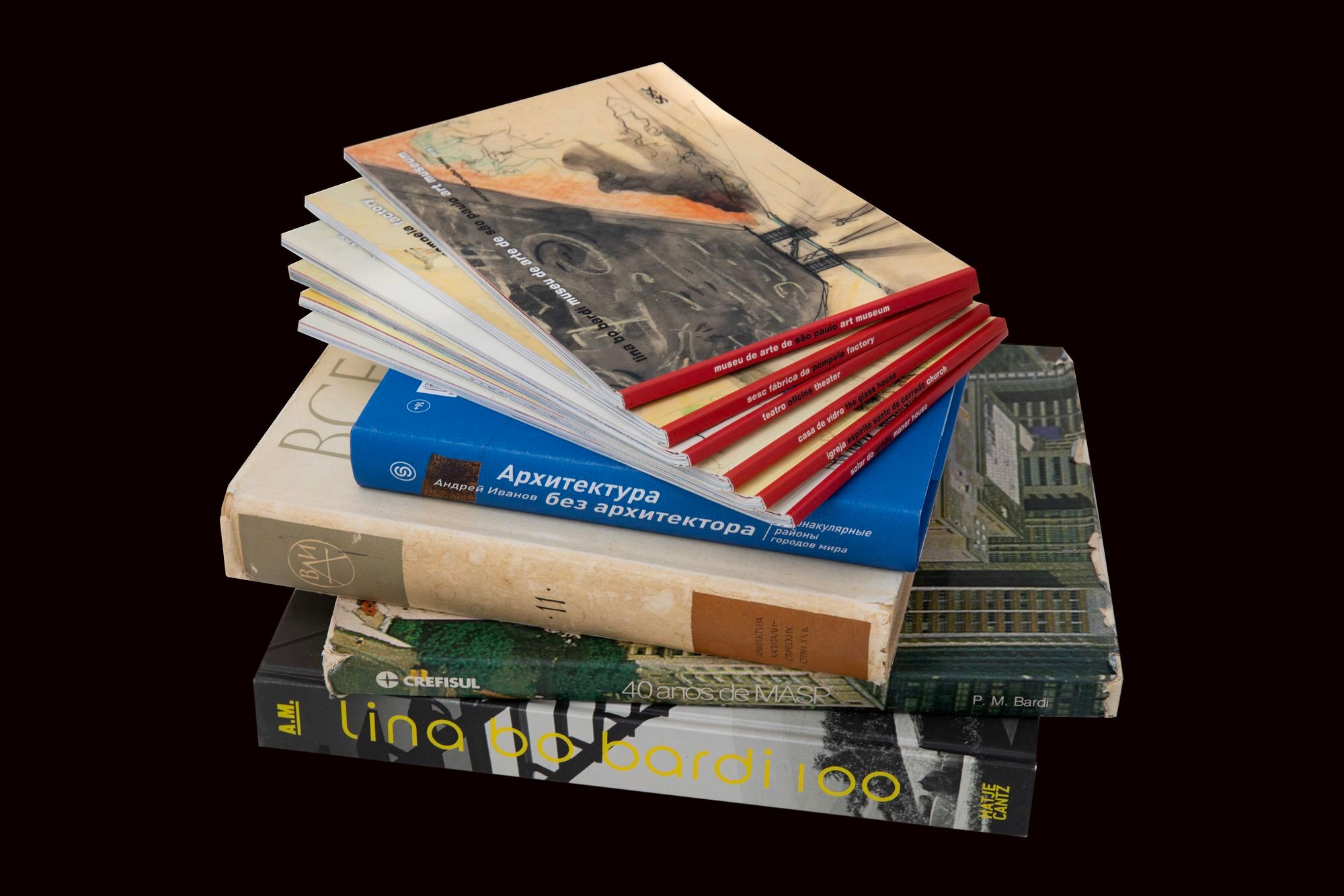
Photo: Anna Zavozyaeva
The If These Walls Were Water exhibition was an all-encompassing exploration of Lina Bo Bardi’s practice as an architect, thinker, curator, and social mediator. Alongside Bo Bardi’s most famous buildings, the exhibition addressed her unique creative method, in which architecture served to foster cultural ties, shared experiences, and collective action.
One of the most important primary sources of illustrations of Bo Bardi’s projects is the Coleção Lina Bo Bardi (2015) series. These six volumes are dedicated to the architect’s most important buildings, including the São Paulo Museum of Art (MASP), the Sesc Pompéia cultural centre, the Teatro Oficina, and the Bardis’ own residence, the Glass House (Casa de Vidro). Each volume contains sketches, watercolours, drawings, archival and contemporary photographs, Lina’s own writings, and the recollections of her collaborators.
Lina Bo Bardi never designed her spaces as finished forms. They “grew” out of observations of life, which became integral parts of them. This approach is clearly visible in the São Paulo Museum of Art project, which is featured in a dedicated book, 40 anos de MASP, written by the institution’s founder and Lina’s husband, Pietro Maria Bardi. Unlike most architectural monographs, this book views the museum building through the lens of its collection—how and for whom it was formed.
Bo Bardi’s vision was revolutionary for its time. She sought to radically democratise the visitor experience, and this aspiration was perfectly expressed by her statement: “New museums must open their doors, and let in fresh air and light.” It was for MASP that Bo Bardi developed her famous glass “easels” for displaying paintings—transparent panels set in concrete blocks in which paintings seem to float in the air. This system allows for free movement between works and makes it possible to view the backs of the canvases, which often bear unique historical traces.
Lina Bo Bardi saw architecture as a way to “consider the past as a living historical present [...] to forge a different, ‘true’ present.” This principle remains relevant today in the context of rapid urban reconstruction, as a result of which memory is often under threat. Marcelo Ferraz and André Vainer, co-curators of the exhibition at
Bo Bardi’s work cannot be viewed in isolation from her interest in vernacular (folk) architecture, which is based on local traditions and materials as opposed to the universalism of the International Style. Similar principles can be traced in projects by Soviet architects in the republics of Central Asia and the South Caucasus which were built with local materials and used perforated walls and courtyards for natural ventilation. Andrei Ivanov’s book Arxitektura bez arxitektora. Vernakulyarny`e rajony` gorodov mira [Architecture Without an Architect: Vernacular Districts of the World’s Cities] (in Russian) shows how unauthorised, self-built buildings form a “flexible shell” for neighborhood life. A parallel can be drawn with Bo Bardi’s “poor architecture” (architettura povera), which employed minimal technology and maximum social energy.
The album Drawing from the Archives is dedicated to the practice of Geoffrey Bawa, one of Sri Lanka’s greatest architects. The publication contains nearly two hundred illustrations documenting a search for balance between modernism and the tropical garden. “Critical regionalism” follows the thesis: "Fit the building into the shadow of a coconut palm“—the same perspective that led Bo Bardi to the Glass House, perched among green canopies.
Vladimir Khait’s monograph Sovremennaya arxitektura Brazilii [Modern Architecture of Brazil] (in Russian) and Volume XI of the foundational series Vseobshhaya istoriya arxitektury` [General History of Architecture] (in Russian), both published in 1973, offer a panorama of the “heroic period” of Latin American modernism during times defined by the authors as the “general crisis of capitalism.” By the mid-twentieth century, Latin American architectural schools had entered the world stage, challenging established architectural conventions. Another important subject addressed by these works is the impact of rapid urbanisation on the emergence of such striking and complex phenomena as the construction of the entirely new city of Brasília.
The catalogue Lina Bo Bardi 100: Brazil’s Alternative Path to Modernism documents the exhibition held to mark the architect’s centenary; it includes many of the original sketches that served as primary tools in Bo Bardi’s expression of her distinct style of architectural thinking. The publication emphasizes Bo Bardi’s ability to create buildings that were immensely popular with the local population while defying traditional classification. The section on the Sesc Pompéia cultural centre shows how the work of the architectural team, who lived right on the construction site, was organised.
The catalogue for the exhibition project Latin America in Construction: Architecture 1955–1980 provides a comprehensive account of how both Americas pursued their own versions of modernism which included university garden campuses and projects for new capitals. Architects from Brazil, Mexico, and Cuba stand out for their ambition to create not just buildings, but vibrant centres of urban life. The publication will be of interest to those who believe that architecture is capable of transforming everyday life through constructive means.
In the collection Architecture and Social Sustainability, new criteria for social sustainability are formulated using the examples of urban environments in Brazil, India, Nigeria, and the USA, recalling Bo Bardi’s insistence on the greater importance of solving social problems than architectural restoration. The biography Lina: The Adventures of an Architect (Russian edition) transforms Bo Bardi’s life into a vibrant comic book story: a girl from Rome, convinced that “architecture cannot exist without people,” settles in São Paulo after years of hardship and learns to build for a “life full of beautiful things and adventures.” The author places special emphasis on Bo Bardi’s beliefs that a home is first and foremost a place for eating, socialising, and laughter, and that every stage of life is a step towards the great art of being oneself.
Bo Bardi’s archive, much like the architectural experiments of the twentieth century, is polyphonic. It is more than just a list of buildings—it is a true laboratory of ideas, in which every sketch, whether for a stage set or a museum building, tells the story of a person open to the future and respectful of the past.