A titanic anti-western unleashing the demons of Brazilian history. Russian premiere of a restored copy in the programme The Rebellion of Dreams. Directed by Glauber Rocha.
Antonio das Mortes
- Date:
- 14 Mar 2026,
16:00–17:40
- Age restrictions
- 18+
O Dragão da Maldade contra o Santo Guerreiro
1969, Glauber Rocha
Brazil–France–West Germany–United States
97 minutes, Portuguese with Russian subtitles
Starring: Maurício do Valle, Odete Lara, Othon Bastos, Hugo Carvana
T
The vast expanses of Brazil’s sertão (hinterlands) are no longer the domain of the cangaceiros—the bandits who once roamed these lands, robbing the rich and helping the poor, but killing both. The last of them was dispatched in the late 1930s by the famed hired assassin Antônio das Mortes, who now wanders the world without purpose or meaning, endlessly reflecting on the blood he has shed. But when the bandit Coirana appears in a town with the telling name Jardim de Piranhas (“Garden of Piranhas”), accompanied by an ecstatic preacher and her flock and promising to revive the traditions of the cangaceiros, Antônio heads there to complete the work of his life with one final killing. He even refuses the fee prepared by the local elites for the heads of Coirana and his companions.
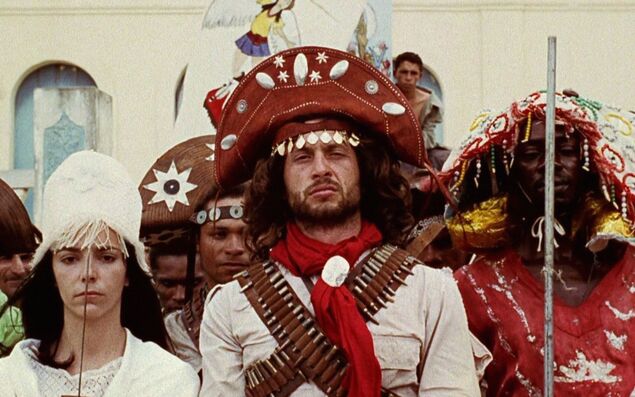
Shot from Antonio das Mortes, 1969
Glauber Rocha grafted his country’s grim and bloody history onto visions of its ongoing military dictatorship to make a political film of grand ferocity and turbulent sophistication.
— Richard Brody, The New Yorker
Antônio das Mortes—a composite figure based on several real but legendary assassins of Brazil’s impoverished Northeast—first appeared in the film that brought Glauber Rocha international acclaim, Black God, White Devil, where he was, of course, an agent of death. By returning the character to the screen, Rocha prepares an astonishing transformation for him, one imbued with revolutionary potential.
The world of this film—brutal, ritualized, and ruled by cynical elites—seems to cry out for revolt. Yet Rocha never resorts to political sermonising, and he does not do so here. Instead, he uses a single confrontation to reveal an entire microcosm of Brazilian life, encompassing not only politics but also religion, culture, mythology, and sexuality. This ideological richness is matched by formal intensity: the film sings and mourns, invokes and denounces, fights and kills, laughs and derides, dies and is reborn—and it grips today’s viewer as powerfully as it did in the late 1960s.