The audience becomes part of an immersive audio event, in which composers of the 16th and 21st centuries transform the
And Yet It Moves
- Date:
- 14 Sep 2026,
20:00–21:30
- Age restrictions
- 6+
Programme
T
Thomas Tallis (1505—1585)
Spem in alium (“I have never put my hope in any other but in thee, God of Israel”), c. 1570
Boris Filanovsky (b. 1968)
Architecton Theta, 2019
Sound sculpture for ensemble, chorus, and listeners in motion
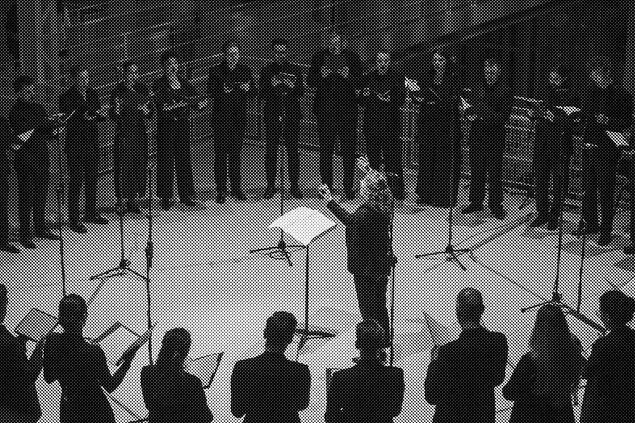
Music traditionally functions in two categories—tempo and pitch. The concert programme And Yet It Moves brings together works by composers of the sixteenth and twenty-first centuries who use a third category—the dimension of space. In works by the master of the English High Renaissance Thomas Tallis and contemporary composer Boris Filanovsky, the audience becomes an integral part of the musical composition: the performers are stationed at a regular distance one from another all around the
Performed by
Intrada Vocal Ensemble, Ekaterina Antonenko conductor
Yaroslav Timofeev concert host
To call Architecton a musical work is really a misnomer. Rather it is an analogue of Malevich’s “movement of pictorial planes”, which I have tried to unfold in time and sound.
From each point you can hear only a part of the Architecton, a part which is at once similar to the other parts but noticeably different from them both musically and by its position in space; you have to change your locus of hearing in order to try and grasp the whole. So the “music itself” is in abstract motion as to its pitch and tempo, while the listeners are in physical motion.
—Boris Filanovsky
The usual concert ritual—musicians on stage, audience in the hall—assumes a collective experience. By contrast, And Yet It Moves allows each member of the audience to choose their own pathway, to try out various scenarios of interaction with sound and trajectories of movement through space, comparing impressions and constructing their own musical script for the evening.
Spatial distancing of the eight five-voice choirs that are required by Tallis’s monumental 40-part motet, Spem in alium (“Hope in any other”), creates a kaleidoscope of musical ideas and vocal lines that the ear can barely follow. The motet will be performed twice, at the beginning and at the end of the programme, enabling listeners to compare different impressions of the piece obtained from different spatial positions and trajectories.
Boris Filanovsky’s Architecton Theta is structured in a similar way. “Architecton” in the work’s title refers to the Suprematist art movement and specifically to the architectural and engineering experiments of Kazimir Malevich. “Theta” (θ) is the first letter of the Greek word theatron, meaning “theatre”. Architecton Theta is not so much a concert piece as an immersive performance. It cannot be appreciated in its entirety from any one point in space, and the listener achieves a smoothly changing acoustic focus by moving around the Prospekt. Interacting with Renzo Piano’s architecture, the composer intertwines instrumental ensemble and choir to create a single sounding body. The main public space at the House of Culture is transformed into a giant musical instrument.
Intrada Vocal Ensemble was founded in 2006 by Ekaterina Antonenko, a graduate of the Moscow Conservatory. It has taken part in many high-profile projects in Russia and abroad, and has won renown as an exceptionally versatile and professional vocal group. In 2019 and 2021, Intrada was voted Ensemble of the Year in Russia by the newspaper Muzikalnoe Obozrenie. The ensemble collaborates regularly with leading ensembles and musicians in Russia and abroad, including the Moscow Soloists chamber orchestra and Yuri Bashmet, the Svetlanov Symphony Orchestra and Vladimir Jurowski, the Russian National Orchestra and Mikhail Pletnev, Le Poème Harmonique and Vincent Dumestre, Il Giardino Armonico and Giovanni Antonini, The Tallis Scholars and Peter Phillips, VOCES8, I Fagiolini and Robert Hollingworth, the Orchestra of the Age of Enlightenment, Frieder Bernius, Stephen Layton, Hans-Christoph Rademann, Peter Neumann, Jean-Christophe Spinosi, and many others. The ensemble has also performed at the December Nights festival at the Pushkin Museum in Moscow.
Yaroslav Timofeev (b. 1988, Novgorod) is a musicologist, lecturer, and regular host of concerts at
You can buy a ticket to this concert in advance at a discount.
27 Jul — 12 Aug: 1200 rubles
13–25 Aug: 1500 rubles
26 Aug — 1 Sep: 1800 rubles
2–14 Sep: 2100 rubles
The cost of a discounted ticket is always 1000 rubles.