The exhibition was conceived and created by artists from Yekaterinburg and Nizhny Tagil, Egor Efremov and Maria Plaksina, during residencies at
Tram to Park. Introduction
- Date:
- 29 Oct 2026–
14 Feb 2027
- Type:
- Age restrictions
- 6+
T
The preferred materials of Efremov and Plaksina are clay and flax, mixed to produce a substance much like adobe, which was used for millennia in the Middle East, Asia and Africa to make sun-dried bricks for house building. The artists aim to work “naturally, like nest-builders.”
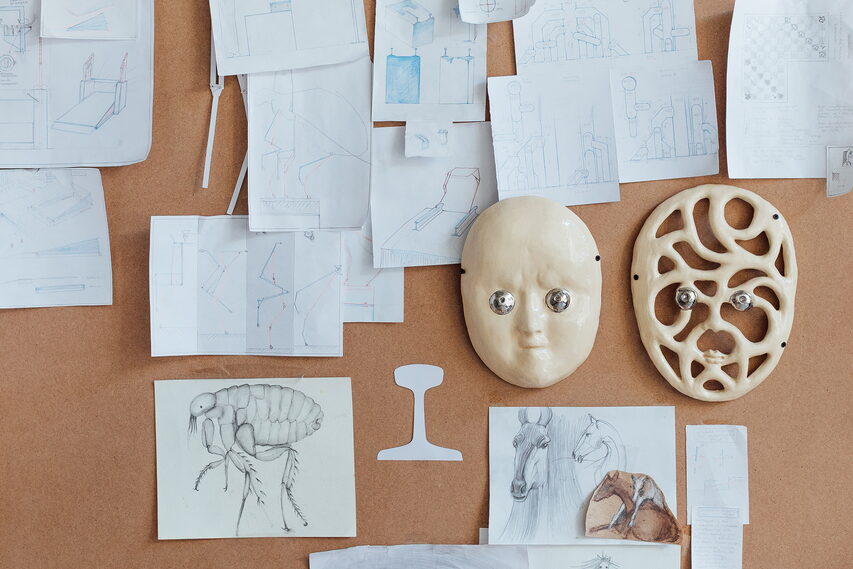
Photo: Vadim Shtein
During the residency, we recorded birdsong and the hum of transformers, collected plants and fruits from Bolotny Island, sorted through heaps of radio tubes and made mechanisms. We reflected on how one can talk about speed through a pause, the perception of space through its compression, about people’s urge to change the environment around them, and about modern technology and the ways you can guess how it works.
—Egor Efremov, Maria Plaksina
The key image of the exhibition is the horse-drawn tram (“konka” in Russian), a form of urban transport that emerged over a hundred and fifty years ago and that existed until electricity made it redundant. The artists saw the konka as a hybrid of the natural and the industrial, a start point for a conversation about how technology influences the perception of time and space.
The exhibition has three parts, arranged along a chronological axis from past to future. The three parts reflect and build on one another through sound, form and material, reminding us that everything in nature and society is interconnected and subject to gradual but inevitable change. The visitor’s journey begins in a konka, where the silhouettes of passengers come to life. The next stop is the main gallery, where more recent times are evoked. Audio installations with biomorphic structures and mechanical parts give an idea of the sounds that were brought to the city by machines and that transformed the acoustic urban landscape. Each of the exhibits can be set in motion, triggering an echo of the past in the present. The third part of the show consists of a single work— the White Horse sculpture in
The title of the exhibition plays on the double meaning in Russian of the word "park"—an urban transport depot and a green space in the city for public use. The word on the front of a tram or bus indicates that it will carry passengers no further than the depot, from where they must go by foot or use some other transport, so there will be a pause and, perhaps, a new set of passengers. In its other Russian meaning, a park is nature in the city, a place of rest and slower rhythm. By combining these meanings, the artists present the konka as a metaphor for "slow progress"—a more thoughtful approach to technology and the environment, an attempt to rediscover tactility and connection with the surrounding world.
About the artists
Egor Efremov (b. 1983) and Maria Plaksina (b. 1989) came together as an artistic collective in 2018. They work in the cities of Nizhny Tagil and Yekaterinburg, drawing on the mythologies and cultures of the East and the peoples of Russia, particularly those of the Urals.
The artists combine traditional techniques and folklore with contemporary themes. They work in various media—sculpture, ceramics and large-scale installations, which are often moulded from clay mixed with straw to resemble adobe bricks or swallows’ nests.
Egor Efremov and Maria Plaksina hold regular masterclasses and open workshops for a broad audience. They have also taken part in many exhibitions at venues across Russia, including the GROUND Solyanka Gallery (Moscow, 2022), Triumph Gallery (Moscow, 2022), Smena Centre for Contemporary Art (Kazan, 2023), ZIM Gallery (Samara, 2023), the PERMM Museum (Perm, 2023) and Arkhangelsk’s Gostiniye Dvory (Arkhangelsk, 2023). Their work has featured in several large-scale projects including the Ecological Art Biennale (Nizhny Novgorod, 2025), the Second Chuvash Biennale (Cheboksary, 2025), the Here and Now public art festival (Moscow, 2021), and the Nemoskva (“More than Moscow”) project (Saint Petersburg, 2020).