This exhibition investigates the architectural, ideological, and socio-cultural continuities between the Soviet mikrorayon and the Vietnamese Khu Tập Thể (KTT; ‘collective compound’ in Vietnamese), situating both within a broader transnational framework of socialist urbanism.
Moscow—Hanoi. Landscapes of Optimism. Introduction
- Age:
- Type:
- Age restrictions
- 16+
T
Emerging from a shared political and spatial imagination, the mikrorayon and KTT were conceived as architectural instruments of socialist modernity—standardised, rationalised, and collective in both form and function. Through archival displays and contemporary artworks, this exhibition explores how a complex interplay of ideology, nature, and everyday life saw the modernist legacy transformed, adapted, and inhabited.
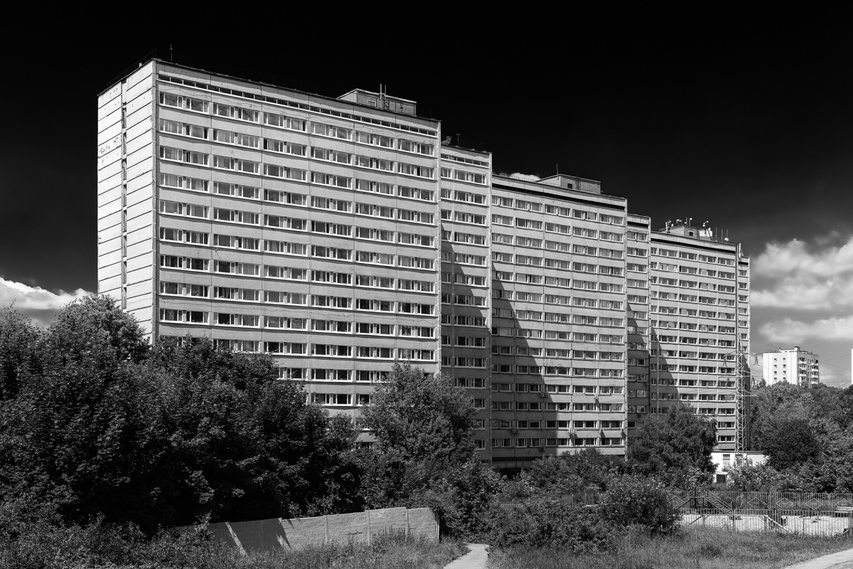
Alexey Bogolepov. Untitled. From the series "Universal Catalogue". 2025
The Soviet mikrorayons and Vietnamese KTTs were both products of postwar socialist optimism, which eventually faded. This exhibition draws our attention to a different kind of optimism, one that emerged as the modernist architectural projects were transformed. Gradually, as a result of the ad hoc solutions generated by individual needs, these buildings, which were originally constructed in line with a constraining, uniform model of the human being, were transformed, rebuilt, and adapted to accommodate a diversity of private lives and idiosyncracies.
The first part of the exhibition considers Moscow not just as a domestic testing ground for architectural standardisation but as a laboratory for globally exportable models. The international language of Soviet modernism—grounded in a scientific approach to the housing question—made Soviet designs attractive on the global market. Beginning in the 1960s, the USSR exported industrial housing technologies abroad, and adapted versions of Soviet panel buildings appeared across Latin America, Africa, and Asia. Through an exploration of experimental planning practices in Moscow and their international dissemination, this exhibition traces the global trajectory of socialist housing, paying particular attention to its modifications in hot climates. The project foregrounds how social housing was not simply replicated but profoundly adapted to suit local environments, communities, and cultures.
The second part of the exhibition addresses the history of social housing in Vietnam. In the 1940s and 1950s, when the Democratic Republic of Vietnam emerged in the north of the country, its capital, Hanoi—where housing was already in critical demand—faced an influx of rural migrants. The Vietnamese government initiated public housing as a provisional solution to accommodate them. Through photography, research, and theatrical performance, this part of the exhibition reflects on Hanoi’s collective housing as a palimpsest of urban life. It explores how residents creatively reshaped these spaces amid rapid redevelopment and reveals the memories of resilience and community embedded in everyday structures, ultimately asking how humane urban futures might honour lived relations.
The transitional part of the exhibition explores stories of community-based urban life, addressing the phenomena of diaspora and immigration in both the Soviet and Vietnamese contexts. Foregrounding the Vietnamese diaspora in Russia and tracing its history to the educational and professional immigration of the 1960s and 1980s, the artworks on display illustrate how Vietnamese Muscovites spatially and emotionally reconfigured their environments in ways that evoked their homeland and helped them adapt to their new context. Through the story of Salon Natasha, the exhibition addresses an instance of migration from the Soviet Union to Vietnam that led to the establishment of a contemporary art space in Hanoi.
The exhibition’s architecture is its discursive and analytical nucleus. Moving through the architectural construction—a multilayered superimposition, or collage, of several Soviet and Vietnamese apartment plans in 1:1 scale—viewers experience the transformation from one typology to another, from the Soviet mikrorayon apartment to the Vietnamese KTT. This spatial and conceptual hybrid does not merely juxtapose the two housing models, but reveals the processes of translation, appropriation, and adaptation that accompany the migration of socialist planning ideals across geographies and climates.