{"points":[{"id":1,"properties":{"x":0,"y":0,"z":0,"opacity":1,"scaleX":1,"scaleY":1,"rotationX":0,"rotationY":0,"rotationZ":0}},{"id":3,"properties":{"x":0,"y":0,"z":0,"opacity":0.4,"scaleX":1,"scaleY":1,"rotationX":0,"rotationY":0,"rotationZ":0}}],"steps":[{"id":2,"properties":{"duration":0.1,"delay":0,"bezier":[],"ease":"Power0.easeNone","automatic_duration":true}}],"transform_origin":{"x":0.5,"y":0.5}}
T

“Never Just a Tree.”
An Essay on a Lost Home and Gained Wisdom
Manisha Gera Baswani contemplates the significance of trees in Indian culture, the art of her guru A. Ramachandran and the heritage Nobel laureate Rabindranath Tagore, as well as her own family history.
Author
Manisha Gera Baswani is an artist, photographer, and writer. Her practice engages with the themes of migration, memory, identity, and the body. Her main interest lies in personal and inherited histories, shaped by her parents’ displacement during the Partition of India. As the Curator of Artist Through the Lens, an ongoing photographic archive of 26 years, she documents artists’ studios. Her project, Postcards from Home, brought together 47 artists from families affected by the Partition of India in 1947. It was presented at the inaugural Lahore Biennale, the Kochi Biennale of 2018, and Oxford’s Ashmolean Museum in 2022.
The exhibition The World in a Single Nest: Following the Way of Tagore, dedicated to Rabindranath Tagore, will open at the
Exhibition partner: Gazprombank (Joint Stock Company).

Manisha Gera Baswani. A Tapestry of Hope Incised, 2017
In the Bhagavad Gita, Lord Krishna says, “There is a banyan tree which has its roots upward and its branches down, and the Vedic hymns are its leaves. One who knows this tree is the knower of the Vedas.” In speaking of this upside-down Banyan tree, he evokes a powerful symbol of purity, calmness, and peace.
Across time and geography, the tree has been the universal parent, nurturing, wise, sheltering, and generous. Every tribe, nation, and community reveres trees. In India, tree worship enters our consciousness right from our childhood. Almost every temple tree is wrapped in a sacred red thread — a moli — a sight deeply familiar to us Indians. The moli appears on wrists, around images of deities, on trays of offerings, and as bonds tying siblings and elders to one another. This ritualistic thread has rather subconsciously found its way into my art practice as well.

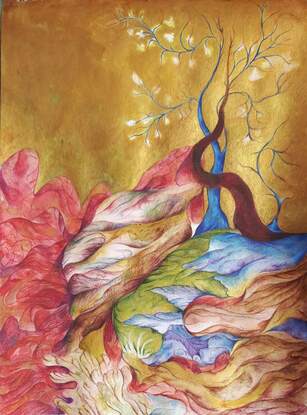
Manisha Gera Baswani. Tapestry Of Hope Woven, 2017; Bejeweled Spring, 2017
Trees are keepers of stories, witnesses to journeys, metaphors for how roots endure even when the land is lost. For me, the tree carries two inheritances, one born of displacement and survival, the other of learning and artistic awakening.
During the tumultuous Partition of India in 1947, my parents crossed the newly drawn borders. They left behind the blue skies and fruit-laden trees of their ancestral homes. Like many others, they spent their first night on this side of the border sleeping beneath a tree outside the railway station. The tree became the ‘home’ they had just lost, a home of generations.
Parallel to this, miles away, my teachers were studying under the canopies of towering trees at Santiniketan, the haven Rabindranath Tagore had built with the belief that learning unfolds under open skies. Nature, for him, was not a backdrop but a teacher, one that shaped perception, humility, empathy, and artistic sensibility.
Somewhere between these two lineages lies my own understanding of home, history, and belonging. The story of the tree in my life begins long before I was born: before my teachers entered my world, and long before I learned to see the tree not merely as nature, but as a companion in human experience. I stand between these legacies, looking upward, seeking answers of the tree as to where and how to belong.
Tagore’s Santinekitan
As a child, Rabindranath Tagore grew up in a sanctuary created by his father, Maharshi Debendranath Tagore at the turn of the twentieth century. It was renamed Santiniketan, the abode of peace. Beneath wide canopies and blue skies, the young Tagore dreamt of a school that broke free from colonial walls and European modernism. He imagined an open-air temple of learning where knowledge blossomed slowly, in the divine presence of nature, where wind, sky, and foliage shaped universal understanding, an inner awakening aligned with the rhythm of the seasons.
His vision culminated in a residential school based on ancient Indian traditions and a spiritual idea of the unity of humanity. He envisaged Santiniketan to be the connecting thread between India and the world that would enable the creation of a world culture founded on principles of multiculturalism, diversity, and tolerance.
Rabindranath maintained that ‘before Asia is in a position to co-operate with the culture of Europe, she must base her own structure on a synthesis of all the different cultures she has. When, taking her stand on such a culture, she turns towards the West, she will take, with a confident sense of mental freedom, her own view of truth, from her own vantage-ground, and open a new vista of thought to the world. Otherwise, she will allow her priceless inheritance to crumble into dust, and, trying to replace it clumsily with feeble imitations of the West, make herself superfluous, cheap and ludicrous’.
Santiniketan became Visva-Bharati University, with the motto: Yatra Viśvam Bhavatyekanīḍam “where the world makes a home in a single nest”. This melting pot attracted scholars, thinkers and great minds from all over the world, growing into a major world education and cultural centre.
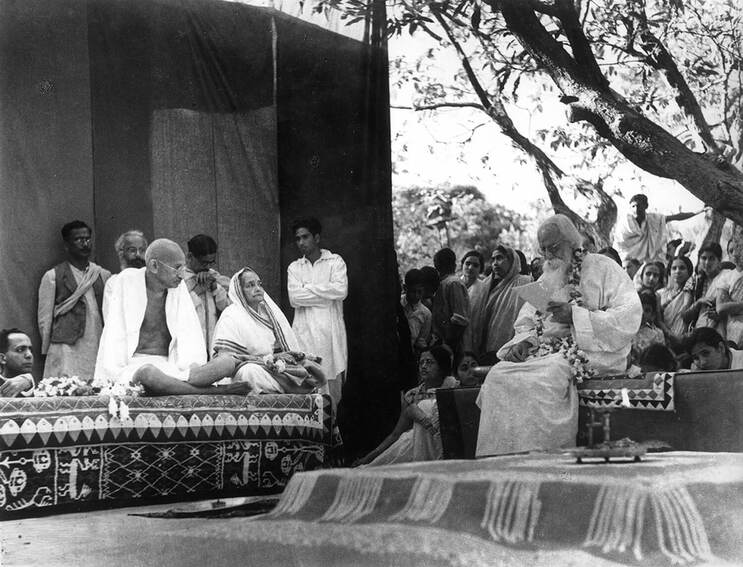
Rabindranath Tagore, Mahatma Gandhi with his wife Kasturba Gandhi at Santiniketan, 1940
Chameli’s Santiniketan
Chameli was born to the eminent Chinese scholar Professor Tan Yun-Shan and his wife, Chen Nai- Wei, whom Tagore had invited to fulfil a mutual vision of realizing a cultural collaboration between the ‘two sister countries’ China and India. He settled in Santiniketan and established Cheena Bhavana, a centre for Sino-Indian studies.
Chameli and her siblings were all born and brought up in Santiniketan. Her sister was named by Tagore himself. They grew up studying and playing in gardens where tall trees swayed in the Bengali wind, surrounded by creative minds from across the world.
Chameli painted trees all her life. Her Chinese-ink landscapes often depict trees from a ground upward gaze, a perspective most familiar to her as she grew up beneath their shade, in the sprawling gardens of Santiniketan. Her works feel like autobiographical meditations on Santiniketan’s spirit.
Under these very trees, she and Ramachandran had met as young students.
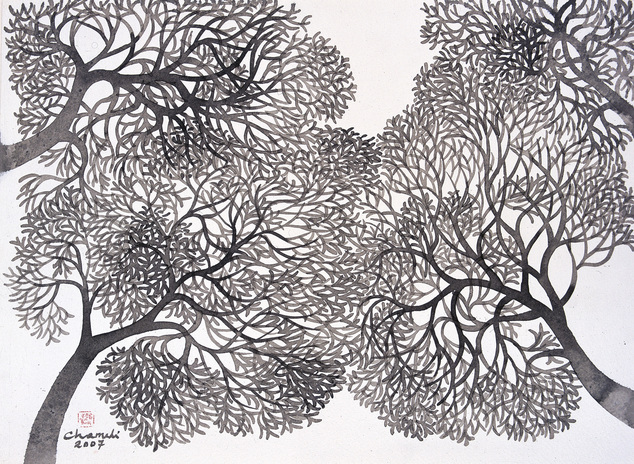
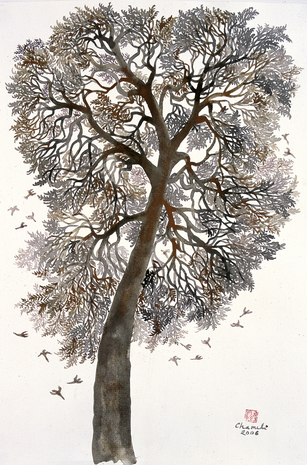
Chameli. Untitled, 2006; Untitled, 2007
My Guru, A. Ramachandran
My teacher, A. Ramachandran Nair, grew up in Kerala, “The Land of Gods”. A childhood of climbing coconut trees, swimming in rivers, and wandering temple grounds painted with centuries-old murals. Immersed in music, ritual, and landscape, he arrived at Santiniketan already fluent in the language of nature and culture.
His journey to Santiniketan seems pre-ordained. During a Carnatic music lesson in Trivandrum, on a table in the classroom was kept an arts journal. Leafing through it, he saw an image of Ramkinkar Baij’s monumental sculpture The Santhal Family. That single image of the artwork lit a fire that drew him across the country to learn from Baij.
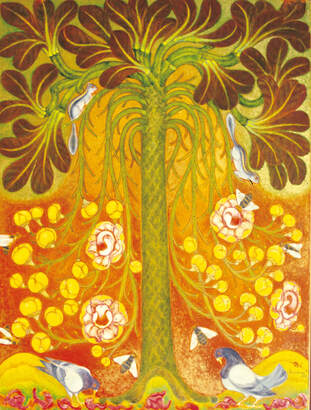
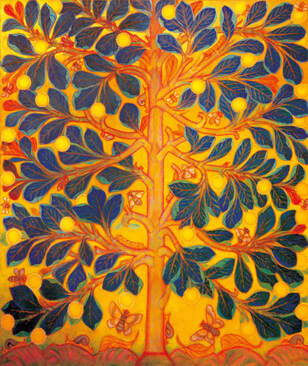
A. Ramachandran Nair. Kadam Tree, 1992; Nagalinga Tree, 1992
In Santiniketan, surrounded by ancient trees, Santhal communities, scholars, and artists, he found his true philosophical home. Nature was not a subject for him but a truth. He became one of Baij’s most celebrated students, and Santiniketan’s ethos was to shape his life and art until his last canvas.
Chameli and Ramachandran later moved to Delhi to start a new life in the bustling capital city. Together they created a garden to live with the echoes of Santiniketan. To them, the tree was not simply nature; it was the living embodiment of Tagore’s vision and their own personal philosophy.
He often reminisced about the towering trees, flowering seasons, and scent of rain when he lovingly recalled Santiniketan to me, his student of thirty-seven years.
Ramachandran would become a celebrated artist in time to come, painting the human figure and the tree side by side, both bearing equal intensity and dignity. In his final months, I used to see him sitting quietly in his garden, gazing into eternity, surrounded by the trees he had planted, returning, perhaps, to a sacred lifelong conversation.
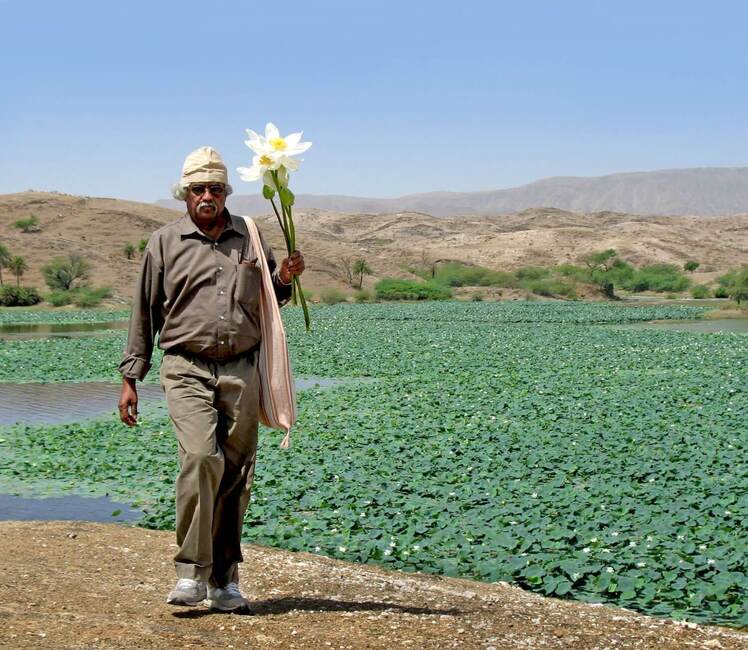
A. Ramachandran Nair with lotus flower
The Tree of Refuge: My Parents’ Journey
Within me resides another tree, one rooted in 1947, standing at a different emotional register. This tree witnessed rupture, not nurture.
Through stories told softly, as if touching old wounds, my nonagenarian parents have often described their childhood, filled with fruit-laden trees shading their courtyards in their homes now across the border in current day Pakistan. They recall the distinct shapes and taste of mangoes, jamuns, and mulberries which now live only in their memory.
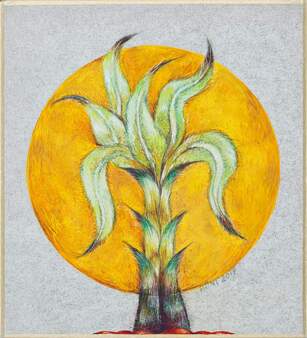
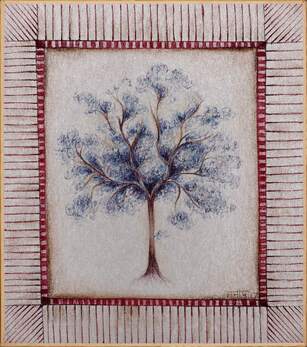
Manisha Gera Baswani. Grishma, 2017; Ekant, 2017
For them, their trees were architecture, identity, and memory. In 1947, they crossed the borders, leaving a home built over generations, never to return. They arrived with a small sack of clothes, silence wrapped around their pain, and no place to call home.
The Partition of India had uprooted 12 million people.
Outside the railway station on this side of the border, beneath an unfamiliar sky, it was a lone tree that received them. It was not a beloved fruit tree of their past, nor a symbol of learning, but it held the same dignity, the same generosity, the same ancient patience as the trees of Santiniketan.
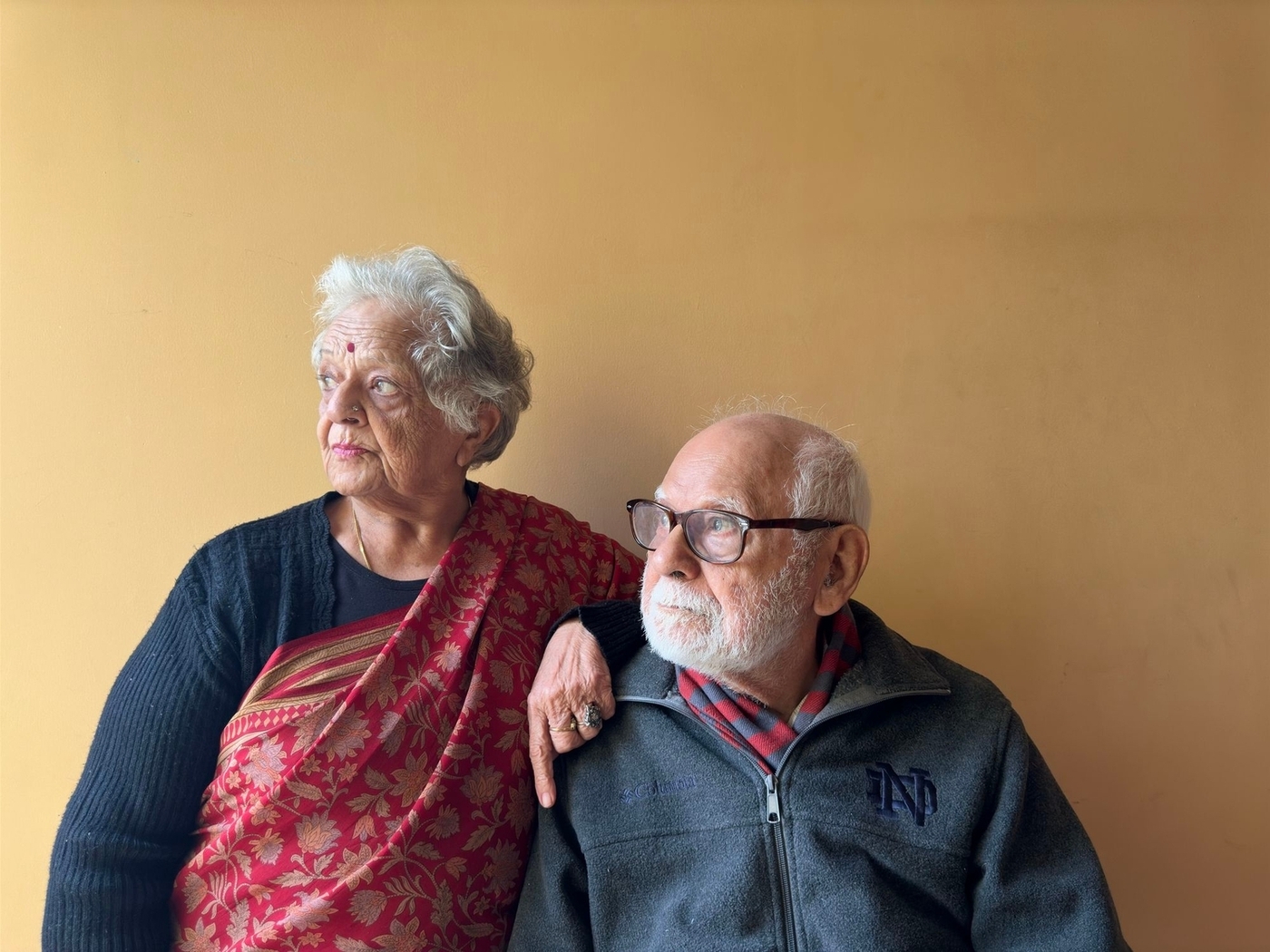
Manisha Gera Baswani’s parents – Om and Versha
They recall spreading a bedsheet over a low branch and sleeping beneath it. That thin cloth now their first roof, the tree, their first home. It was comforting shelter after unimaginable rupture, a fragile threshold between homelessness and the beginning of a new life.
Even now, as they approach their mid-nineties, they recount the story with a tremor, a memory of loss, survival, and profound gratitude for something as ordinary and extraordinary as a tree.
My Tree: Between the Two Worlds
From my parents, I inherited the tree of survival, the tree that became home when home was lost. From my teacher A. Ramachandran and his wife Chameli, I inherited the tree of Santiniketan, the tree of artistic awakening and philosophical openness.
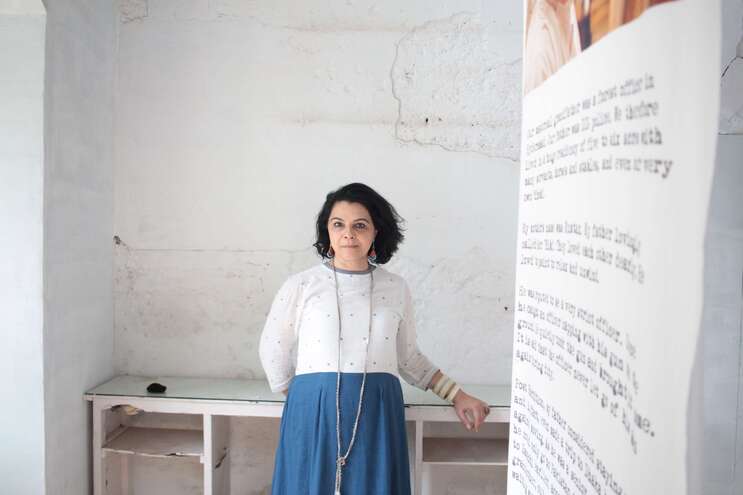
Manisha Gera Baswani
One stands under the trembling sky of 1947, giving refuge to two exhausted refugees. The other stands in the sunlit courtyards of Santiniketan, nurturing two young minds who would later shape my life.
My parents’ tree and my teachers’ tree rarely intersect in the physical world. And yet, within me, they have grown into a single root system forming the compass by which I understand home, history, art, and resilience. I am reminded constantly that a tree is never just a tree and a home is not always a structure built by hands. Sometimes it is the patch of shade where two refugees once slept. Sometimes it is the open-air classroom where a young student looked up at the sky and discovered who she could become.
Standing beneath a tree, I feel my parents’ gratitude, my teachers’ reverence, and Tagore’s wisdom drifting like a quiet thread of blessing.
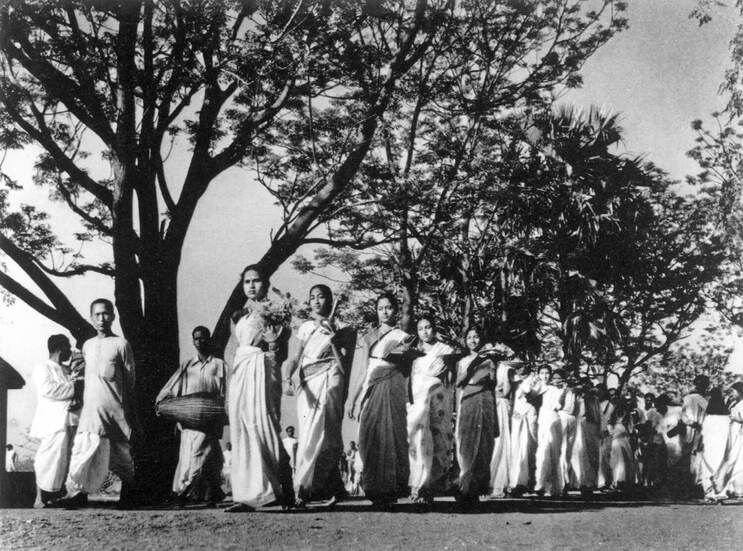
Vriksharopana Utsav – celebration in Santiniketan, 1935–1941
Santiniketan continues to celebrate Vriksharopana Utsav, the tree-planting festival, since 1928. Songs, dances, and the planting of saplings honour Tagore’s belief that harmony between humans and nature is essential to life, culture, and learning.