{"points":[{"id":1,"properties":{"x":0,"y":0,"z":0,"opacity":1,"scaleX":1,"scaleY":1,"rotationX":0,"rotationY":0,"rotationZ":0}},{"id":3,"properties":{"x":0,"y":0,"z":0,"opacity":0.4,"scaleX":1,"scaleY":1,"rotationX":0,"rotationY":0,"rotationZ":0}}],"steps":[{"id":2,"properties":{"duration":0.1,"delay":0,"bezier":[],"ease":"Power0.easeNone","automatic_duration":true}}],"transform_origin":{"x":0.5,"y":0.5}}
T

Bringing food creates something extra. On the art of connection at the dinner table
In this interview, two artists from different parts of the world, who share an interest in communities formed around meals, reflect on the symbolism of leftovers, moments of loneliness, and the way food is linked to memory.
Author
Alexander Yegorov — a Russian artist working with photography and digital technologies. His practice addresses themes of excessive consumption, information overload, and the aesthetics of imperfection.
Iftikar Ahmed — is an author, art critic, and cultural theorist working at the intersection of aesthetics, politics, and the Indian psyche. He writes on Indian art, criticism, and cultural power, moving between history, theory, and the present moment.
The artists met when Alexander Yegorov participated in a residency exchange program with the Indian project Khoj.
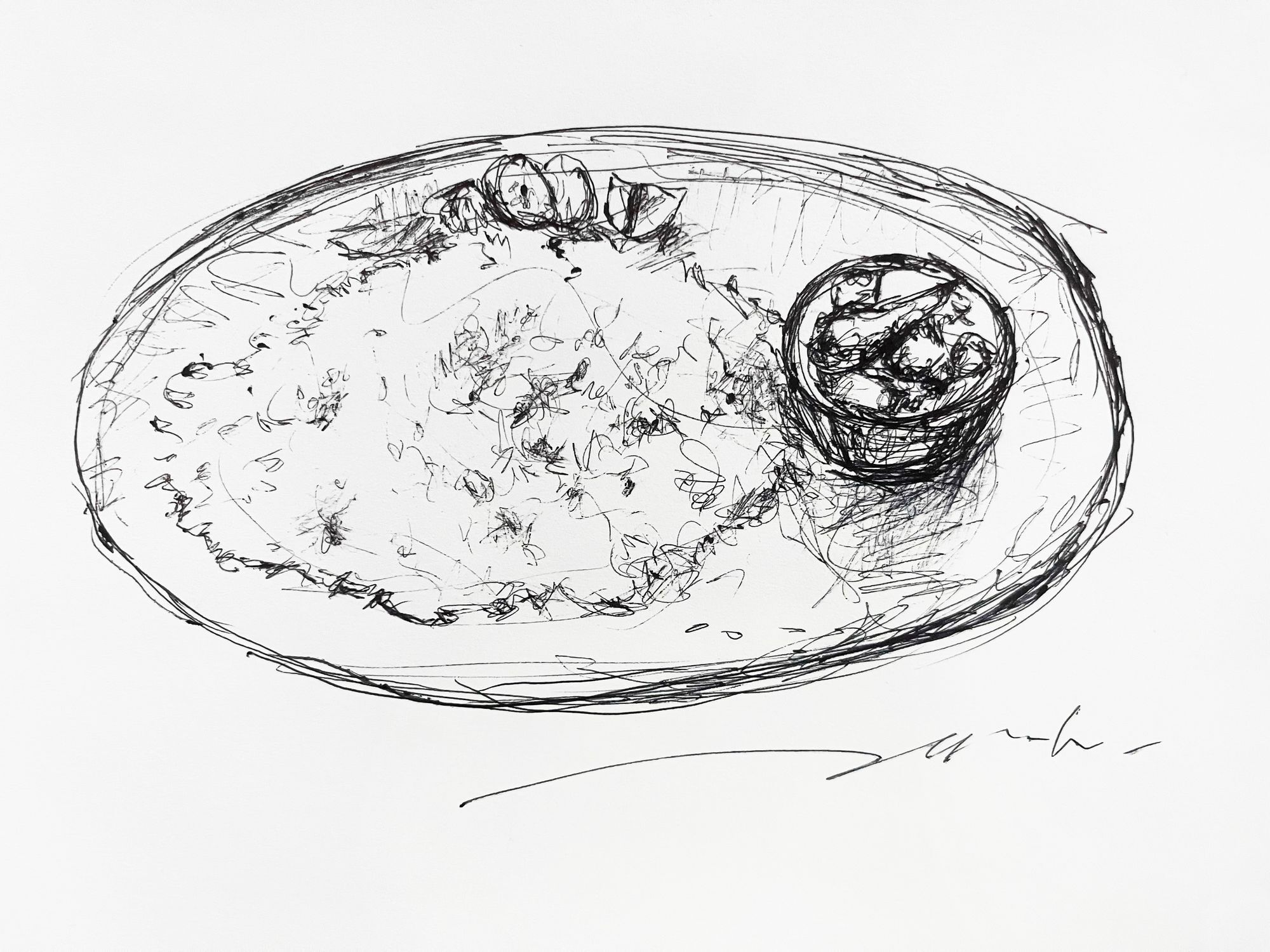
Iftikar Ahmed. A plate of rice and chicken with some salad (2026)
[Alexander Yegorov] We are interested in the concept of food as something that creates a special space for people around the table. I understand that in Eastern traditions this aspect is particularly important, with specific practices such as sharing dishes and eating by hand. Could you tell us a little more about your childhood and your traditions? Is there a particular film, book, artwork, or memory in Eastern culture that shaped your interest in food as an artistic subject and medium?
[Iftikar Ahmed] I understand the assumption about India, but even within India there is no single “Eastern” tradition. My father served in the Indian Army, so my childhood involved moving across different regions of the country. With each move came new languages, music, clothing, and food cultures. Yet for a long time, I did not think of food as cultural or aesthetic. It was simply functional, something you eat for energy, health, and survival.
My relationship with food began to shift much later. In 2019, during my first international trip to Lebanon, I encountered food not just as nourishment but as a social and sensorial experience. Meals created a shared space, a rhythm of conversation, generosity, and attention. That experience made me look back at my own upbringing differently and recognise how food silently structures intimacy, memory, and belonging. It was only then that food emerged for me as a subject capable of carrying meaning, emotion, and artistic inquiry.
[Alexander Yegorov] This is a functional aspect of food which is really important for every person. Do you feel there is something special about food as an artistic medium, and in general do you feel like food is an important topic in the art world of India today as an art? As an art historian and curator, do you feel this theme is relevant at all?
[Iftikar Ahmed] Absolutely. Food is not only relevant as a subject today, it is increasingly unavoidable. Many galleries and institutions are actively trying to engage with food, especially within the context of the white cube. Bringing food into a gallery immediately unsettles its conventions, because the white cube was never designed for smell, taste, decay, or consumption. It was designed for looking.
If we think about art historically, most forms privilege specific senses. Architecture and sculpture operate through form and space, painting through vision, music through sound. Food, however, activates the body differently. It engages taste, smell, touch, time, and social proximity. It resists passive viewing and demands participation. This alone makes it a powerful artistic medium.
At the same time, it creates real friction. Older galleries operate with strict protocols for conservation and control. Food introduces risk, impermanence, and disorder. So, the question is not only whether food belongs in the gallery, but what happens to the gallery when food enters it. In that sense, food is not just another medium. It becomes a critique of the institutional structure itself, forcing us to rethink how art is experienced, preserved, and shared.
[Alexander Yegorov] Why do you think they are interested in when bringing food into this space? What’s in it for them?
[Iftikar Ahmed] You can engage with art not only through your eyes and ears, but also through taste. Bringing food into an art space creates something extra. And this “extra” can change depending on the context, the place, and the audience. It adds another layer of experience that is not always possible with more traditional media.
If you think about works like Maurizio Cattelan’s banana, it is not really about the object itself. It is more about the idea and the instructions the artist is following. In a similar way, when food enters the gallery, it is not just about eating. It is about the concept, the framework, and how the experience is staged and understood.
[Alexander Yegorov] Bringing back your personal approach, I remember your essay about leftovers: you recall different kinds of food, the ones that you would prepare for your family and friends, and the other ones for yourself. I noticed that hospitality seems to be a strong part of Indian culture. Everybody, when I was there, was happy to feed me.
[Iftikar Ahmed] When I was growing up, eating meat or fish was not an everyday thing. It was more of a novelty. Whenever a guest came to our house, there was a clear effort to prepare something special, usually meat or fish, and much more time and care went into those meals. Food for guests was never casual. It was deliberate.
There is also a longer historical and cultural idea at work. Feeding a traveller, someone who has no place to rest, has always carried symbolic weight. Food creates a sense of safety and belonging. I have lived in Delhi for over a decade now, away from my parents and family, and there were moments when people fed me not out of obligation, but because they sensed loneliness. In that way, food becomes a quiet form of care, a way of acknowledging another person’s vulnerability.
[Alexander Yegorov] Loneliness is the topic of my next question. I wanted to ask, from your personal perspective, what is the difference between eating alone and eating in company, like at a party or at any event that involves more than two people? Can you imagine a situation where you might feel lonely at a table with lots of people?
[Iftikar Ahmed] Most of the time, when I ate with friends, it was never really about the food. It was about conversations, about what was happening in our lives. The food was present, but it almost became invisible. It functioned as a backdrop. As for loneliness, over the past few years I have internalised it. I see it as part of our existence. Does eating in company reduce loneliness? I want to believe it might, but I am not sure. There is an inner world and an outer world, and unless you are at ease with the inner one, the outer does not necessarily help. I enjoy having people around while eating, but I am also comfortable eating alone. In fact, I sometimes feel uneasy eating in large groups. At parties, I usually do not eat. I drink, I snack, and I wait until everyone leaves. That is when I eat properly.
[Alexander Yegorov] Quite aligned with your functional approach! You’ve hosted the party; you have responsibilities. My next topic is about leftovers, which is a topic and an entity we both seem to be interested in. I wanted to ask you to talk more about leftovers as non-human agents that can shape human behaviour, or be witnesses to what is happening at the table.
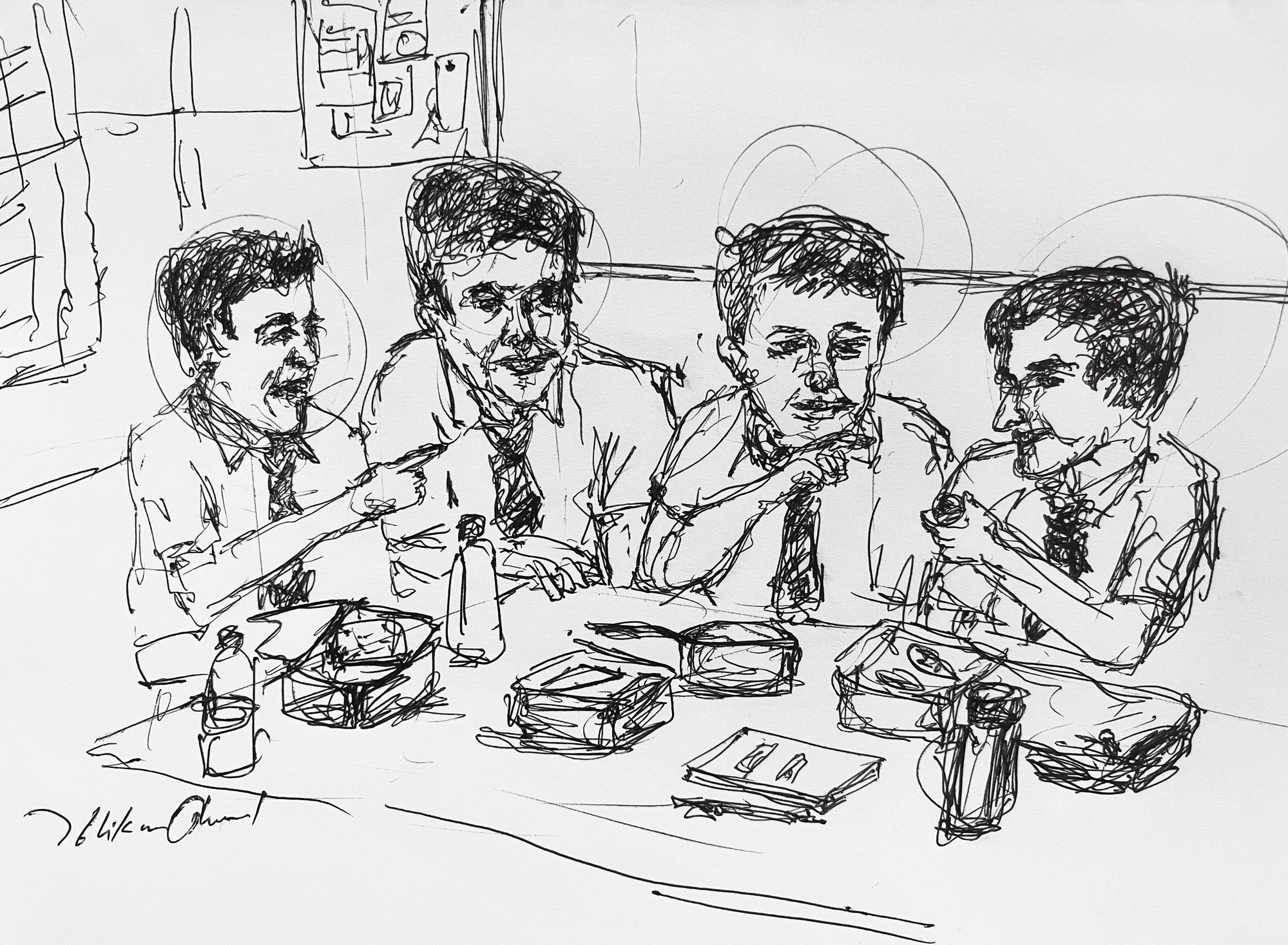
Iftikar Ahmed. Bantering around food (2026)
[Iftikar Ahmed] Leftover food is not meant to give you freshness. And yet, in a time when we are constantly chasing newness, it does something strangely opposite. It can make you feel grounded. Especially when you think about how much content we consume, how quickly things lose value. Leftovers sit quietly against that impulse.
There is something intimate and ironic about them. You once wanted something badly, you consumed part of it, and then you abandoned it. Leftovers carry that history. They are evidence that something happened. I do throw food away, like everyone else, but I also have preferences. I enjoy certain leftovers more than others. In that sense, leftovers begin to shape behaviour. They decide what you return to, what you ignore, and what you are willing to live with one more time.
[Alexander Yegorov] You have this almost poetic approach to leftovers. Do you perceive them in the same way as ruins in general?
[Iftikar Ahmed] Even as ruins, they carry a certain sentimental value. I do not really see leftovers and ruins as separate things. For me, they overlap. As a student of history, I am used to thinking in overlaps. History rarely moves in clean breaks. It moves through continuity and change at the same time, and leftovers exist in that same in-between space.
[Alexander Yegorov] Overlapping, but not the same, right? I guess this theme of food resembling ruins, in a way, is about memory and I do think meals and food can serve as memory in the same way that you associate certain smells with certain events or with certain places in your life. Do you think food is the same in this regard?
[Iftikar Ahmed] Yes, and this brings me back to your earlier question about food as art. What is art, really? It is not just objects. It is what we feel, what we remember, what we desire, and how we relate to our own history. Art holds all of that together.
Food works in a similar way. It has the power to carry memory. When you encounter a certain fruit after many years, it can suddenly trigger nostalgia. And nostalgia often comes with a sense of safety. You taste it, and you are taken back to a specific place, a specific time, a particular sweetness. But when you return to that place later, you realise that time has moved on, and so have the things around it. That gap between memory and change is where food, like art, quietly operates.
[Alexander Yegorov] You mentioned that you have been traveling a lot in your life. Do you feel that food can help you recreate your home in a sense?
[Iftikar Ahmed] Definitely. Right now, nothing compares to going back home and eating a meal cooked by my mother. That kind of food carries a feeling that cannot really be replicated elsewhere. It settles you.
At the same time, there are a few simple dishes I have learned to cook for myself. They are not complicated, things like mashed potatoes. When I make them, it feels enough. Your stomach is full, but more importantly, your heart is full too. In that sense, food does help recreate a sense of home, even when you are far away from it.
[Alexander Yegorov] Food is a really broad theme, embracing health, social, and economic aspects. And I wanted to ask you about the caste system in India: What role does it play when it comes to food? And in what ways can it manifest in everyday life?
[Iftikar Ahmed] As I mentioned earlier, my upbringing was slightly different because of my father’s job in the army. We moved constantly and lived in cantonments where caste distinctions did not really operate in everyday life. You lived in the same buildings, went to the same schools, shopped at the same places, and used the same hospitals. In that environment, these divisions felt largely absent.
It was only later, after my father retired and I came to Delhi to study, that I encountered the reality more directly. Meeting people from across India, I heard about the restrictions they faced around food and access. Some were not allowed to drink water from certain taps, enter certain villages, or even walk on particular roads. Food became a clear marker of exclusion. As a Muslim, I have also experienced this in a different way. While looking for rental housing, I was often asked about my religion, and once it was known that I eat meat, doors would quietly close.
Vegetarianism and non-vegetarianism operate as social codes in India. Vegetarianism is often linked to ideas of purity and moral superiority, particularly among upper-caste groups, while meat-eating is stigmatised. Food, in this sense, becomes a way of maintaining hierarchies, not just through what is eaten, but through who is allowed to eat where, and with whom.
[Alexander Yegorov] Is it possible for people from different castes to be at the same table?
[Iftikar Ahmed] On the surface, it may seem possible, especially in large cities. In places like Delhi, these divisions are less visible, and people often share tables without openly acknowledging caste. But that does not mean the problem has disappeared.
If you move away from metropolitan spaces to second-tier cities or smaller towns, these hierarchies become clearer. In some primary schools, children still refuse food from the hands of the person serving it because of their caste. So yes, people may sit at the same table, but equality at that table is far from guaranteed.
[Alexander Yegorov] Today, it may seem that people are becoming more distant, which is kind of a paradox because technology is supposed to bring people together. Do you think food can be a uniting factor in this sense?
[Iftikar Ahmed] I sometimes feel that people are becoming more like robots, while robots are becoming more human. But there is one important difference. Robots will never be human because they do not eat food. So yes, food is something I remain quite optimistic about. We are at a point in history where borders feel increasingly porous. Technology has connected us, and we like to think of ourselves as global citizens. But food keeps us grounded. We have Chinese food, and we also have Indian versions of Chinese food. I enjoy dim sums and momos, and whenever I travel, food becomes an easy starting point for conversation. In that sense, food continues to create connection in a way technology alone cannot.